

NATO emergency talks on tap as U.S. commander assesses defenses after Russian missiles hit Poland, Ukraine carries out attack on Russian warship, and suicides at NSA, U.S. Cyber Command prompts push to expand Pentagon reporting.
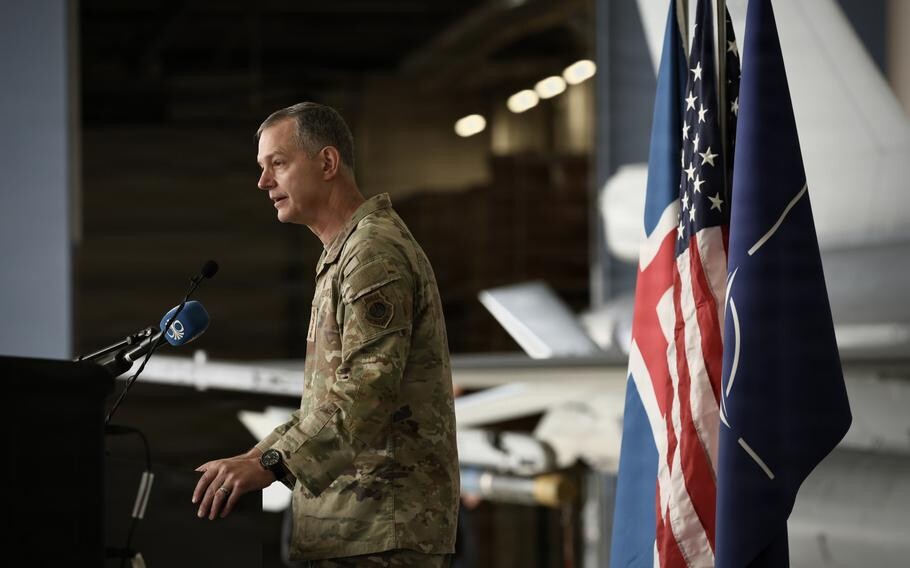
1. NATO’s top decision-making body will meet Monday to discuss Russian missiles that crashed in Poland, while the U.S. general in charge of allied forces in Europe will assess if defenses need strengthening following the latest incursion into alliance territory. NATO Secretary-General Mark Rutte said Saturday in Warsaw that Gen. Alexus Grynkewich, the alliance’s supreme allied commander in Europe, would examine potential threats and make defensive adjustments as needed, according to the Polish Press Agency. The developments come as Poland presses NATO for additional air defenses after two suspected Russian missiles and a drone entered its airspace Friday. “I can guarantee that NATO will defend every inch of Polish territory,” Rutte told reporters. The North Atlantic Council, NATO’s highest decision-making body, will meet Monday in Brussels to discuss the violations, Polish officials said over the weekend.
2. Ukraine carried out an attack on a Russian warship moored at a port in Libya, President Volodymyr Zelenskyy said Monday, claiming that sea drones sank the navy vessel in a surprise assault the previous day. Ukrainian forces deployed seven domestically made sea drones in the operation, which struck the Russian navy corvette in the Mediterranean, according to Zelenskyy. The ship was one of Russia’s newest vessels, commissioned a year after Moscow launched the 2022 invasion of its neighbor, the Ukrainian leader said in a post on X. Kremlin spokesman Dmitry Peskov declined to comment on the attack, saying that Russia’s Ministry of Defense would provide more information “if deemed to be appropriate.” The operation, conducted some 2,400 kilometers (1,500 miles) from the front line in Ukraine, was the latest daring long-range assault by Kyiv’s forces.
3. Five deaths by suicide among personnel supporting the National Security Agency and U.S. Cyber Command — first documented through internal military communications and public records — have prompted a push to expand Pentagon reporting requirements to civilian employees, whose deaths can fall outside the system Congress established for troops. Rep. Sarah Elfreth, D-Md., wants the annual defense policy bill to require civilian suicide data and broader reporting of clusters following the deaths over five weeks in June and July at Fort Meade, Maryland, which Bloomberg News and The Baltimore Banner reported included both service members and civilian staff, though officials have not released a full breakdown. The proposed reporting changes would address a distinction that separates colleagues working on the same national security missions. The effort accompanies a request for $11 million for Cyber Command mental health support. In an Oct. 7 letter signed by Elfreth, Sen. Chris Van Hollen and Maryland's congressional delegation, lawmakers said classified work, prolonged operational demands and inconsistent access to embedded care leave personnel vulnerable to burnout while complicating their ability to seek assistance. Their funding request treats workforce health as a readiness concern.
4. The U.S. Army plans to invoke emergency provisions to avoid a court order that had put on hold plans to detonate several tons of bomb-making chemicals in Iowa, saying that continued delays will make it more dangerous as the weather starts to turn colder. “To protect its personnel and the surrounding communities, the Army needs to take swift action,” government lawyers told the 8th U.S. Circuit Court of Appeals in a filing late Saturday. “Protection of human health and the environment demand action now, not delay.” The Army said Sunday evening that it plans to detonate the chemicals Wednesday “to allow for optimal weather conditions” and for all mitigation measures to be put in place. Environmental groups criticized the government’s move, decrying it as a maneuver to get around a court order and avoid public demands for safety and transparency.
5. The U.S. Navy’s second-largest overseas theater command will soon lose its four-star billet as part of a broader NATO restructuring that ensures all three of the alliance’s operational commands are led by European countries. Adm. George Wikoff, who leads U.S. Naval Forces Europe-Africa and Joint Allied Force Command Naples, will be the last American four-star officer to serve in those roles. NAVEUR-AF and U.S. 6th Fleet will transition to a single staff, under a single three-star commander with a unified mission, Cmdr. Laura Stegherr, a NAVEUR-AF spokeswoman, said in a statement Saturday. “This change will streamline command-and-control functions while continuing support to U.S. forces, the NATO Alliance, and partners across the European and African theaters,” Stegherr said. The restructuring comes as the Navy navigates increasing, simultaneous demands across Europe, Africa and other theaters while the U.S. presses its NATO allies to assume more of the burden for their defense.
- Security