

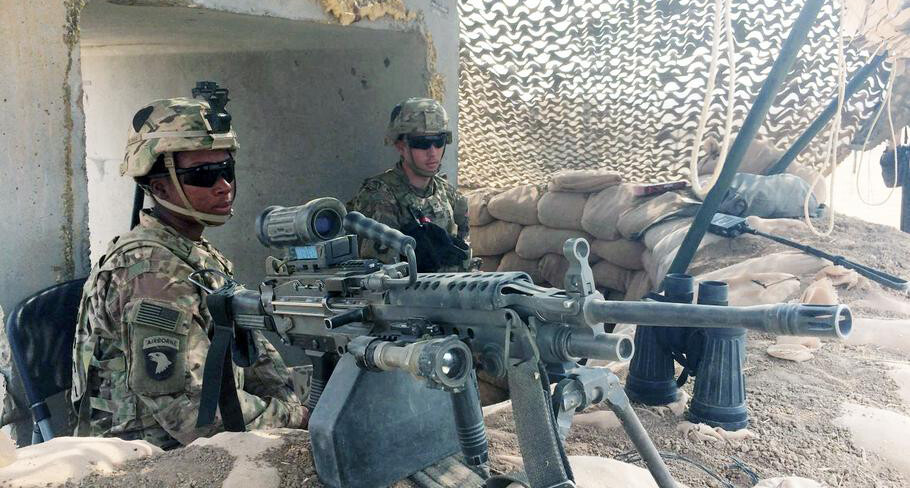
U.S. military formally ended its mission in Iraq, the Pentagon said, closing another chapter in more than two decades of American combat operations, withdrawals and returns to a country that was the defining battlefield for a generation of troops.
The U.S. military formally ended its mission in Iraq, the Pentagon said Wednesday, closing another chapter in more than two decades of American combat operations, withdrawals and returns to a country that was the defining battlefield for a generation of troops.
The conclusion of Operation Inherent Resolve in Iraq, the campaign launched in 2014 to defeat the Islamic State group, ended the latest chapter of U.S. military involvement that began with the invasion of the country in March 2003.
“This milestone reflects the success of a 12-year campaign that defeated ISIS as an organized military threat in Iraq and across the region,” Pentagon chief spokesman Sean Parnell said Wednesday in a statement. “It also marks a transition from a wartime coalition mission to an Iraqi-led security effort supported by a more normal bilateral security relationship,” he added.
The coalition task force overseeing Operation Inherent Resolve is headquartered in Jordan. The Pentagon’s announcement concerned the end of its mission in Iraq.
American troops invaded Iraq in 2003 and toppled Saddam Hussein’s government in short order, only to then become tangled in an insurgency and sectarian conflict that dragged on for years.
About 4,500 American service members died in Iraq during more than two decades of war and subsequent operations.
U.S. forces largely withdrew at the end of 2011, leaving only a small military contingent attached to the U.S. Embassy. But that absence proved to be short-lived.
Less than three years later, Islamic State fighters had overrun Mosul and Tikrit and seized roughly a third of Iraq, while Iraqi military units collapsed in the group’s path. With the entire country at risk of being overrun, the U.S. in 2014 launched an airstrike campaign against ISIS in a mission dubbed Operation Inherent Resolve.
The effort, which also involved U.S. special operations forces on the ground, eventually included dozens of countries.
Over the next few years, ISIS lost most of its territory, but the mission persisted as U.S. and local forces rooted out remaining elements of the group to prevent its return to power.
While ISIS no longer controls the vast stretches of territory it once did, smaller elements of the group remain active. Iran-backed militias also remain a force in the country.
The Pentagon said local government forces are now positioned to ensure the country’s security.
“We expect the Iraqi Security Forces, including the Peshmerga and other security forces in the Iraqi Kurdistan Region, to lead the continuing effort to secure Iraq and keep ISIS remnants suppressed,” Parnell said. “The Department of War will continue to provide targeted training and intelligence support to our Iraqi partners.”
Besides supporting combat missions, U.S. and allied militaries also have played key roles in building up Iraq’s military over the years. Some of that work continues, albeit outside of Iraq.
In March, NATO pulled military trainers from the country because of dangers associated with the U.S.-Israeli war with Iran. NATO staff were shifted from the Baghdad area to southern Italy, where they continue to carry out training activities remotely.
“Despite operational constraints linked to remote working, (NATO Mission Iraq) reported continued progress in developing national strategies across (Iraqi security institutions),” NATO said in a statement Monday.
Still, the U.S. departure from Iraq could carry risks. In the Kurdish region, government officials say fallout from the U.S.-Iran conflict has complicated security matters. The area has faced scores of drone and missile attacks since March.
“The U.S. leaving the Kurdistan Region in such complex regional conditions, without providing any defense system, is a cause for concern,” the local government said in a statement to Kurdish media.
Meanwhile, Iran-linked groups in Iraq have celebrated the U.S. withdrawal.
“The expulsion of the occupation forces, defeated, from the land of Iraq is the beginning of full sovereignty,” Abu Mujahid al-Assaf, a security official with the Kataib Hezbollah militia, said in a statement cited by The Associated Press.
- Security