

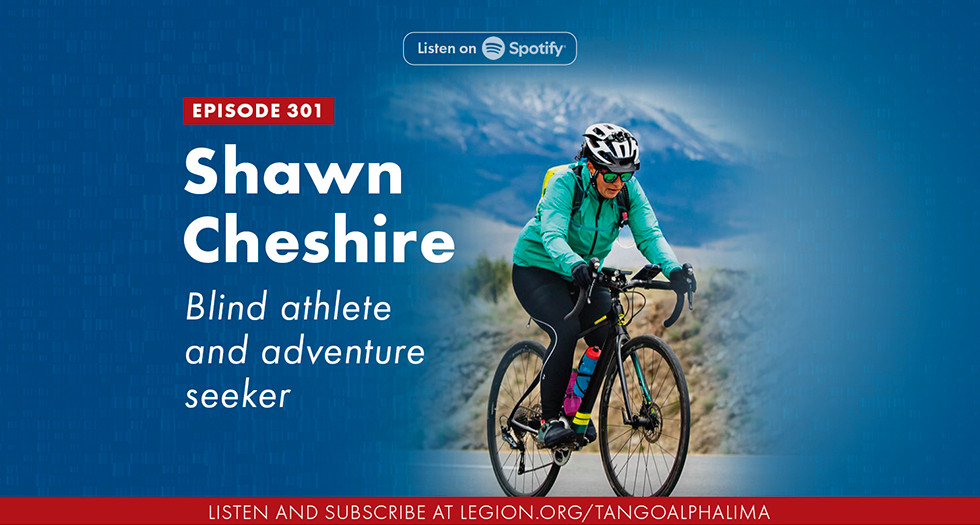
Shawn Cheshire overcame the loss of her vision to become a 13-time Paralympian champion, the first blind woman to complete the Grand Canyon’s Rim to Rim to Rim solo and an inspiration to others.
“I could be dead. I could be a drug addict, alcoholic, selling my body, homeless. I could have been any of it. And my parents were horrible humans.”
Army veteran Shawn Cheshire shares her remarkable and inspirational story in the new Tango Alpha Lima podcast, capturing where her journey began and how far she’s traveled. The Army veteran, 13-time U.S. para-cycling national champion, and Paralympian is living proof that your starting point doesn’t determine your destination.
Cheshire joined the military at age 17 to escape from extreme child abuse. She scored exceptionally well on her ASVAB and chose a path that would give her a “chance of a lifetime”— becoming an armament systems mechanic on AH-1 attack helicopters, an MOS that had just opened to women.
Her photographic memory, which had gotten her accused of cheating in school, made her a natural at troubleshooting complex aircraft systems. “I could just see something and remember what I saw,” she explains, describing how she would outpace male colleagues in diagnostics challenges.
After eight years of service, Cheshire transitioned to civilian life and trained as a paramedic, finding purpose in patient care. But in 2010, at age 36, her life changed forever. A combative patient with dementia pushed her backward in an ambulance, causing a traumatic brain injury that would eventually leave her completely blind.
“I didn’t know I was going blind,” she recalls. “I fought it. I was in denial.”
Even as her vision deteriorated, Cheshire continued working, terrified of losing her livelihood as a single mother. When doctors finally took her driver’s license and told her she couldn’t work, depression consumed her. She attempted suicide twice.
What pulled her from the darkness wasn’t just one thing, it was a network of support.
The Syracuse VA, her mobility instructor, and Team Red, White and Blue showed up consistently, refusing to let her give up. Her mobility instructor made a handmade tether and took her to a running group where a local woman, Chrissy Quijano, a former college softball player and a Team RWB volunteer, stepped forward without hesitation to guide her.
“I ran four miles that day. I thought I was going to die,” Cheshire remembers.
But something shifted. By the end of that run, she was asking about the next race. Two months later, she completed a 10-mile race with significant hills, crying through the finish with overwhelming emotion and accomplishment.
That first race planted a seed that would grow into an extraordinary athletic career. When a male coach told her she’d never be good enough to make the Paralympic Games, Cheshire took it as a challenge. She made Team USA and competed in the 2016 Paralympic Games, eventually becoming a 13-time national champion in para-cycling.
But Cheshire didn’t stop there.
Tired of hearing sighted people say blind people can only ride tandems, she decided to ride a single bike across America, following noise to navigate. She became the first blind woman to complete a double crossing (Rim to Rim to Rim) of the Grand Canyon in under 24 hours, beating the blind men’s record by four hours. Her latest achievement: completing one of the toughest endurance races in the world along the Continental Divide.
"I don't want someone to tell me what my limitations are,” she says. “I want to be curious and discover those myself."
Her journey is captured in the new documentary “Blind.”
The documentary addresses hard topics — childhood abuse, domestic violence, her father’s crimes, and the brain injury — combining powerful visuals with raw honesty. “It was one of the first times in my entire life that I ever felt seen and heard.”
Today, through her nonprofit Choosing to See, Cheshire helps other blind and visually impaired people pursue their goals without financial barriers. Her message is clear: “You don’t have to be anything like where you came from, but you’re going to have to work really, really hard and be very intentional about how you choose to live your life.”
Also in this episode, co-hosts Stacy Pearsall, Adam Marr and Joe Worley riff on:
• The BEACON Act, which represents a shift toward innovation, accountability and hope for veterans with invisible injuries.
• A shoutout to a 17-year-old with a heart, an idea and a love for veterans.
• The magic of audio books.
- Tango Alpha Lima