

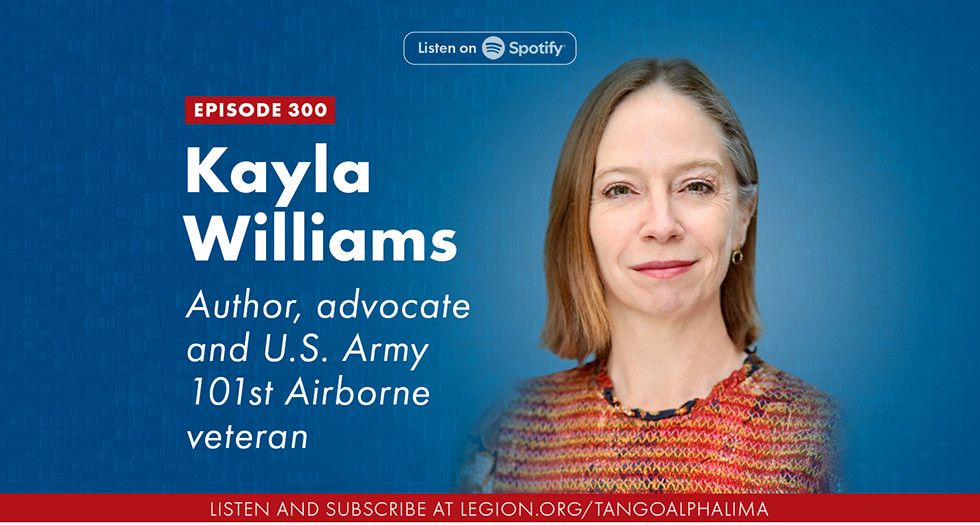
Army veteran Kayla Williams talks about the role of women in combat, recovering from brain injuries, fighting for veterans and more in this episode of Tango Alpha Lima.
When Army veteran Kayla Williams deployed to Iraq in 2003 as an Arabic linguist with the 101st Airborne Division, she went without body armor plates. The reason? According to military regulations at the time, women weren't supposed to be in combat, so they didn't need the same protection as their brothers in arms.
But regulations didn't stop the rockets and roadside bombs. And they certainly didn't stop Williams from doing what the mission required: accompanying infantry on combat foot patrols through Baghdad, serving as the crucial bridge between American forces and Iraqi civilians, especially women who couldn't speak to male soldiers due to cultural restrictions.
In this new episode of the Tango Alpha Lima podcast, Williams — now a nationally recognized author, policy expert, and advocate for women veterans — reflects on her service, her advocacy work, and what still needs to change in military and veterans policy.
The power of hope in the hardest moments
For Williams, the most defining experience wasn't the combat itself. It was what came after. When her husband, also a veteran, sustained a severe traumatic brain injury from a roadside bomb in Mosul, doctors told the couple he wouldn't see any more improvement after 18 months.
"That was harder than the s---," Williams says. "You can deal with a terrible situation, but if you think the terrible situation is never going to end, that is overwhelming. I could handle Iraq because I'm going home. You can do anything for a year, but to think that you're going to have to do something forever, that was too much for me."
That sense of hopelessness drove Williams to document their recovery journey in her second book, Plenty of Time When We Get Home. Her husband defied the prognosis. Thanks to neuroplasticity and years of therapy, he continued to improve and eventually went back to college. Williams wanted other families to know that healing is possible, even when it feels impossible.
"I really wanted to show people that there is a path forward," she explains, "that you can see healing, see gain, see improvements if you're willing to put in the work, even years later."
Fighting for women in combat
Williams' advocacy has long focused on ensuring that military policies reflect the realities on the ground. It took a decade after her deployment for the military to formally lift the ban on women in combat roles, a policy change she fought hard to achieve. Now, more than a decade later, she's watching those gains come under scrutiny once again.
"The question — ‘Can women hack it in combat’? — has been asked and answered so thoroughly,” Williams says. "I'm feeling tired, feeling tired of having to re-litigate things that we've really covered quite thoroughly already."
Her message to military leaders and policymakers is clear: merit should determine who serves in what roles — not gender, race, or artificial barriers. With ongoing recruiting challenges, she argues, the military needs to open — not close — doors to every qualified person.
Advocating for evidence-based solutions
After her military service, Williams used her GI Bill to attend graduate school and spent over eight years at the RAND Corporation conducting research on military personnel and veterans policy. She later served in senior roles at the Department of Veterans Affairs, including running the Center for Women Veterans and the Office of Public and Intergovernmental Affairs.
Her approach has always been grounded in evidence.
"I don't want people to get scammed," she explains. "And if we're talking about taxpayer dollars, it's really important that we use taxpayer dollars for things that actually work and not just snake oil or somebody's personal pet project."
She's seen significant progress since her own service such as improved mental health care, open conversations about PTSD, and policy changes related to sexual harassment and assault. But she knows there's still work to be done.
A call to The American Legion
When asked what veteran service organizations like The American Legion can do better, Williams emphasized the importance of recognizing the diversity of today's veteran population and remembering that women have served and continue to serve.
"Just really making sure that folks understand that we're out there, that we're serving," Williams says, "and to always approach us with that same level of respect that you would give to anybody else who served."
Also, Tango Alpha Lima co-hosts Stacy Pearsall, Adam Marr, and Joe Worley discuss:
• Some of the many paths veterans can pursue to gain SMC eligibility.
• A VA policy change that will be a big step for women veterans health care.
• How veterans can protect themselves against scammers.
• The legend of Cafe Ground Zero.
Don't miss this inspiring conversation. Subscribe to the Tango Alpha Lima Podcast on Spotify, YouTube, Apple Podcasts, or wherever you listen. Join a community that celebrates authentic veteran stories and proves that service is a lifelong commitment.
Your stories. Your service. Your community. This is Tango Alpha Lima.
- Tango Alpha Lima