

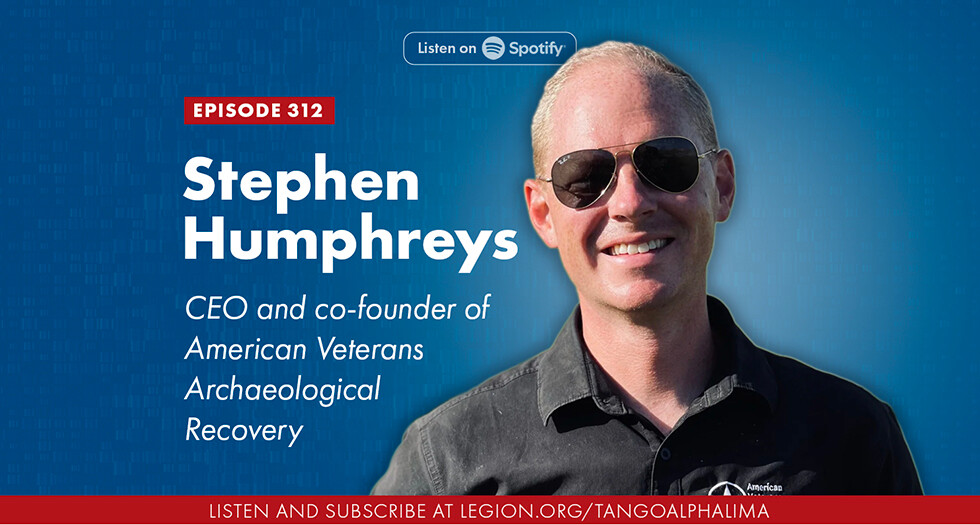
Former Air Force officer Stephen Humphreys is the special podcast guest this week, where he talks about finding archaeology as a career pathway.
When former Air Force officer Stephen Humphreys arrived at his first archaeological dig in Israel, he had no idea what he was getting into. In the military, he had deployed in support of operations in Iraq and Afghanistan, and he had enrolled at a seminary in Fort Worth, Texas, on the GI Bill with the vague intention of becoming a chaplain.
Then someone mentioned there was a dig.
“I think by 5:30 I decided, ‘No, I’m doing this instead,” Humphreys says on this week’s episode of The American Legion Tango Alpha Lima podcast. “I’m touching stuff that’s 3,000 years old. The last person who touched this, their fingerprints are in it. It’s hard to describe in words what that actually feels like.”
That morning in Israel eventually led to a doctorate in archaeology from Durham University in England, a discovery of a British program using battlefield digs to help wounded veterans and the realization that nothing like it existed in America. Humphreys set out to change that. He co-founded American Veterans Archaeological Recovery (AVAR) in 2016.
AVAR isn’t a therapeutic recreation program, it’s a career catalyst.
“Don’t tell people that I can’t do this,” Humphreys recalls an Army veteran telling him during COVID, pushing back hard against the volunteer model AVAR started with. “I can.”
That moment reoriented everything.
AVAR shifted from putting veterans on academic digs as a feel-good experience to building a professional pipeline. They train veterans in systematic metal detection, excavation technique, GIS analysis, and cultural resource management (CRM), then pay them as working archaeologists.
“Sympathy isn’t going to get you hired,” Humphreys says. “It’s going to get you a nice sob story and it’s going to get people interested in who you are. Maybe. But in the end of the day, it’s not going to get you that job.”
Today AVAR crews are professionals. They hold bachelor’s and master’s degrees. They work nationally significant sites — the Second Battle of Saratoga, Fort Ticonderoga, the Battle of Camden, and this summer, Bunker Hill. They have directed excavations with the Defense POW/MIA Accounting Agency recovering the remains of servicemembers lost in World War II, including an ongoing effort to locate a B-25 crew that crashed in Sicily in 1943.
Why military sites, why veterans
The match between veterans and battlefield archaeology isn’t accidental. Humphreys describes the work as almost meditative — the kind of total focus that quiets intrusive thoughts without ever calling itself therapy.
“When you’re in the ground, that’s all you’re thinking about,” he says. “You’re not thinking about any place you’ve been. You’re not thinking about those dark thoughts. You’re thinking, I’ve got to make all the bad dirt go away from this pile of stones.’”
The work serves a deeper purpose.
Veterans, Humphreys has found, aren’t just curious about military history in the abstract. They ask the same questions their counterparts from other eras were asking — about kit, about fields of fire, about what it was actually like on the ground. A Marine sniper reading the terrain at a Revolutionary War battlefield brings something no civilian archaeologist can.
“That 16-year-old kid at the Battle of Camden,” Humphreys says, “he’s gone. He never wrote anything. But we can still find him with archaeology, and we can still tell his story. And he’s still one of us.”
AVAR has recorded three positive identifications through DPAA partnership missions — three families who received a phone call, and a set of remains, after eight decades of not knowing. During one excavation, a class ring surfaced in the screening dirt. It was eventually returned to the fallen airman’s family.
“For us,” Humphreys says, “that makes all of this worthwhile.”
How to get involved with AVAR
Veterans with an honorable discharge — regardless of disability status — are encouraged to apply through AVAR’s website. The entry point is typically an ACAST (AVAR Conflict Archaeology School) program, a roughly month-long field experience currently offered at the Battle of Camden site in South Carolina and through DPAA missions overseas.
Also in this episode, TAL hosts Adam Marr and Joe Worley:
• Break down three archaeology and military history claims, including whether Revolutionary War sites have anything left to find (they do) and whether WWII MIA remains can still be recovered after 80-plus years (they can).
• Discuss a sailor’s encounter with an unwanted ingredient in his Monster Energy drink.
Subscribe to the Tango Alpha Lima Podcast on Spotify, YouTube, Apple Podcasts, or wherever you listen.
Your stories. Your service. Your community. This is Tango Alpha Lima.
- Tango Alpha Lima