

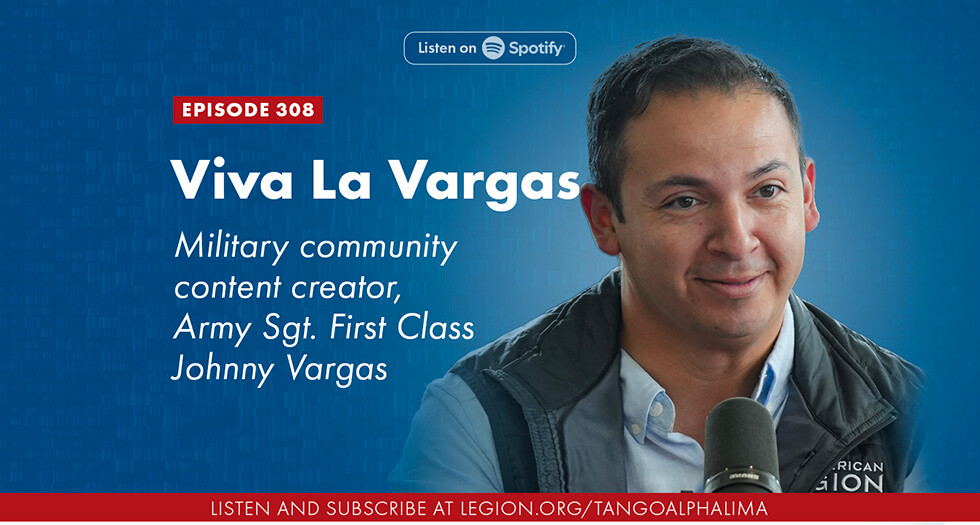
In the new Tango Alpha Lima episode, Johnny Vargas chats about his journey from aspiring recording artist in Los Angeles to one of the military community's most trusted and entertaining voices online.
By the time Staff Sgt. Johnny Vargas — also known as Viva La Vargas — finishes telling a story, you’ve laughed, maybe teared up and almost certainly learned something. That combination, it turns out, is no accident.
Vargas, an active-duty senior enlisted soldier whose content reaches tens of millions of viewers each month, joined the hosts of The American Legion Tango Alpha Lima podcast for this week’s riveting episode. Vargas talks about the winding road that led him from the streets of Los Angeles to becoming one of the military community’s most influential voices online.
Growing up in Los Angeles, Vargas didn’t come from a deeply military family. His grandfather served as a cannon crew member in the Army during Korea. His uncle was in the Marine Reserves. But the thread connecting family history to his own enlistment was something far more impulsive — and a little cinematic.
While attending Bakersfield College, Vargas spotted a car on fire in a parking lot. Without hesitation, he sprinted toward a nearby building, hoping to find a fire extinguisher. “I was so ready to break some glass,” he laughed, recalling how he’d imagined a more dramatic scene before discovering the extinguisher was simply behind a door. He put out the fire. The firefighters arrived. And something clicked.
“I would blame my mom,” he said, when asked where that instinct came from. “She was always the ‘hey, what’s going on over there — let’s go check this out’ type. She would always say yes.”
The very next day, he walked into a recruiting station and said, “Sign me up, brother.”
From guitar to go viral
Before the uniform, there was a microphone.
Vargas was a recording artist in California, performing, writing music, doing showcases. It’s also where he met his wife, at an event connected to Mark Wahlberg’s nonprofit. He even has a footnote in music history: he was present in the studio when the drums for Rihanna and Jay-Z’s “Umbrella” were recorded.
“By recorded, I mean I hit a button and I got to mix them a little bit,” he clarified, laughing. “I didn’t play the drums. I know the drummer.”
That creative instinct eventually migrated online. After completing the Master Resiliency Trainer course at Fort Riley, Vargas was energized to help servicemembers and their families overcome mental obstacles. He started posting on TikTok and Instagram almost as a hobby. He would share quotes, personal stories and small moments of connection. Nobody was watching. That was fine.
Then he did a funny skit — a true story, dramatized — about a sergeant major forcing soldiers to work the military ball after they’d declined to buy tickets. It took off. “No matter what you did in the military, whether you served in the ‘70s, ‘80s, ‘90s, now — we all have a super similar experience,” he said. That realization became the foundation of everything he’s built since.
Three pillars and a question
Vargas now thinks about every piece of content through a clear lens.
“I have three pillars: make people learn, make them laugh, or make them cry — and not physically cry, but tell emotional stories and really connect with an audience.” Veterans benefits and military news satisfy the first. Skits and comedy satisfy the second. Personal stories about self-harm, assault and resilience satisfy the third.
Before posting anything, he asks himself a simple question: “Why would somebody send this to another veteran? Why would somebody send this to their mom?”
That discipline, combined with a commitment to staying nonpartisan, has built something rare — genuine trust across a deeply diverse audience.
“I have audience members that are straight, that are gay, that are trans, that are Christians, Jewish, atheists and all these different walks of life,” he said. “I just want to be able to help them.”
He compares the relationship to a marriage: “If I were to take them out for dinner only once every couple months, the relationship is not gonna flourish as well as it should.”
When a TikTok changes a life
The clearest measure of what Vargas has built isn’t in view counts. It’s in phone calls.
He described two recent examples. When a first sergeant reached out because a soldier with size-20 feet couldn’t get properly fitting boots and was wearing red sneakers everywhere he went, Vargas worked his network until he found a company in Korea that would make custom boots, which he paid for.
Then there was the Babsky family. Their son Asher was diagnosed with a terminal brain tumor at 3 years old. He couldn’t breathe without machines and couldn’t leave the house without a portable oxygen concentrator.
For years, the family had battled their insurance company — which at one point billed them $800,000 erroneously for a brain surgery. The mother worked restaurant shifts until one or two in the morning to cover medical bills. They reached out to Vargas when they couldn’t get the oxygen concentrator covered.
Vargas made two phone calls. The first was to Tony Grinston, CEO of Army Emergency Relief. “I need like five grand,” Vargas told him. He said: “Johnny, stop. I’ve heard enough. It’s a yes.” Days later, the family had the oxygen concentrator. The second call, to Jim Lorraine of America’s Warrior Partnership, produced a grant to help pay down the family’s medical debt.
“That was just from a TikTok,” Vargas said. “If we can accomplish all that just from a silly little informational Instagram reel, just imagine what we could do changing a policy or writing something into law.”
The road ahead
When asked where Viva La Vargas goes in the next five to 10 years, Vargas didn’t hesitate for long. He’s become increasingly involved with members of Congress, senators and VA leadership. So the idea of running for office, even at the local level, is something he’s no longer dismissing.
“There’s some work to be done here,” he said.
But whatever comes next, he closed the conversation with the message he most wanted listeners to hear, one aimed especially at the servicemembers and veterans in his audience:
“It’s totally normal to be sad. I’m sad all the time. But it’s less normal when you try to keep that to yourself.”
He urged everyone — men, women, “cats and dogs, I don’t know” — to speak up when things are hard, and to lean on their circle. “You don’t want to be a burden to people. But the bigger burden would be you leaving this earth at your own hands and leaving everyone with a lot of questions. You are not the burden.”
Also, Tango Alpha Lima hosts Stacy Pearsall, Adam Marr and Joe Worley discuss:
• A new veteran-founded nonprofit that is focused on turning veterans into business owners or vetrepreneurs by providing hands-on support through business training, mentorship and access to funding.
• Remembrance tattoos that can be part tribute, part therapy or deeply personal.
• Women Veterans Day, which is June 12. It is more than just honoring women — it’s about honoring trailblazers.
Follow Johnny Vargas at @VivaláVargas on Instagram, TikTok, YouTube, Facebook, X, Threads, and LinkedIn.
Don’t miss this inspiring conversation. Subscribe to the Tango Alpha Lima Podcast on Spotify, YouTube, Apple Podcasts, or wherever you listen. Join a community that celebrates authentic veteran stories and proves that service is a lifelong commitment.
Your stories. Your service. Your community. This is Tango Alpha Lima.
- Tango Alpha Lima