

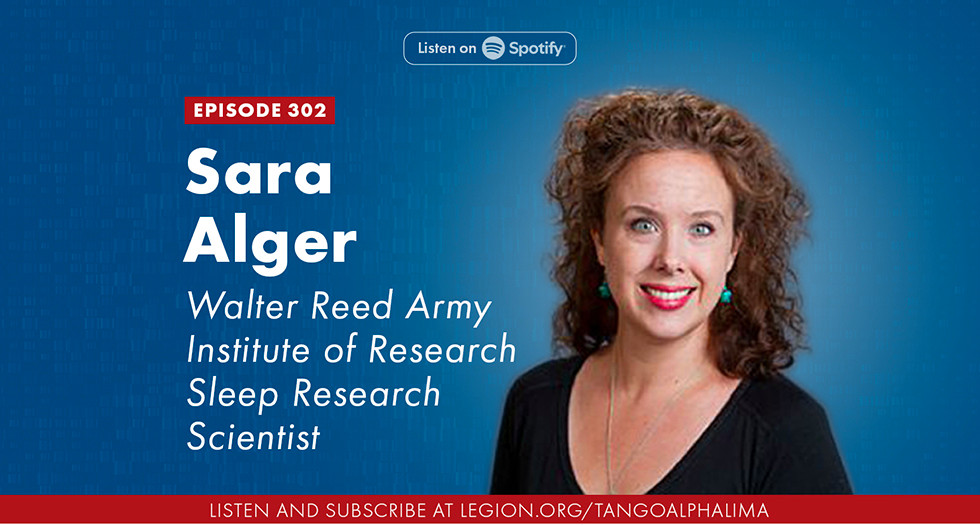
Dr. Sara Alger, sleep research scientist at Walter Reed, explains what chronic sleep deprivation is doing to your brain and body — and what you can do about it — in this week’s podcast.
We have all been there. Consecutive restless nights spent tossing and turning. Unable to sleep due to PTSD, depression or other issues. Another week of sleep deprivation, another day of pushing through on caffeine and willpower, telling yourself you’ll catch up on the weekend.
But here’s what Dr. Sara Alger, sleep research scientist with the Psychological Health Branch at the Walter Reed Army Institute of Research (WRAIR), wants you to know: that mindset is costing you more than you think — and it doesn’t have to.
In this week’s episode of the Tango Alpha Lima podcast, Alger breaks down the science of sleep in a way that hits especially close to home for veterans and servicemembers. Among the key takeaways: what you learned to survive in uniform may now be working against you.
We’re intentionally publishing this episode in March, which is National Sleep Awareness Month, a great time to highlight the important role sleep plays in overall health.
At WRAIR, Alger is continuing her previous research by identifying alternate beneficial sleep strategies, including tactical napping, to intentionally improve health and performance in the operational environment. She is also interested in pursuing advanced methods of monitoring fatigue, predicting performance and intervening to reduce risk to the warfighter.
The research is clear, Alger says. Most adults need seven to nine hours of sleep per night. Chronically getting six hours or less — something nearly every servicemember has done — sets off a chain reaction that goes far beyond feeling tired.
“In the short term, you’ll see things like emotion dysregulation, harder to sustain attention on tasks, and risk-taking behavior getting a little out of control,” she explains. “If you do it chronically, you’re going to have long-term health effects — increased risk for diabetes, hypertension, heart disease.”
After all, while you sleep, your brain literally cleans itself. It flushes out the same toxins associated with neurodegenerative diseases. Cheat on sleep long enough, and those toxins accumulate. “As you age,” she says, “that’s going to be toxic.”
Alger draws a direct comparison most veterans will recognize on a gut level. After 24 hours awake — or just five consecutive nights of five hours — your cognitive performance matches someone at a 0.08 blood alcohol concentration level. That’s legally impaired. That’s driving home after a 24-hour duty day.
“I think there is still very much a culture of ‘I’ll sleep when I’m dead,’” she says. “But you can actually use sleep as a tool — to perform better, to meet the mission with less injuries, less illness. It’s not just something that happens when you’re weak.”
Changing that culture starts with leadership buy-in and honest education. Alger is pushing for it from inside Walter Reed, and she’s seeing slow but real progress.
Host Stacy Pearsall asked a question that many veterans have: “What about the adrenaline surge that jolts you awake the moment you start to fall asleep?” For those trained in a combat environment to treat sleep as a threat — and that wiring doesn’t just switch off when you come home.
Alger validates the experience.
“In an operational environment, sleep is not safe,” she confirms. “It’s taking you offline. So it’s something that almost has to be retrained.” Her recommendation: work with a sleep professional trained in Cognitive Behavioral Therapy for Insomnia (CBT-I). It’s not about medication, it’s about rewiring the stress response that’s keeping you awake.
She also addresses the 3 a.m. wake-ups that so many veterans and aging adults experience. It’s not a disorder, she explains — it’s a natural shift in sleep architecture that gets more pronounced with age, compounded by natural cortisol spikes in the early morning hours. Fighting it with anxiety only makes it worse. The goal is to stop treating wakefulness as failure and start working with your body’s rhythms instead.
Alger offered the concept of tactical napping.
A 20-minute nap in the afternoon isn’t laziness, she says. It follows your body’s natural circadian dip, boosts alertness and improves emotional regulation. Alger has fought to get sleep pods into Walter Reed. “Let’s make this part of the culture,” she says. “It works in other cultures. Why can’t we adopt this?”
What is Alger’s single most important piece of advice? Awareness. “If you think six hours is enough, it’s not,” she cautions. “Be aware that it’s not. And then figure out what you’re going to do about it.”
For practical resources — including a tactical nap guide — visit WRAIR.health.mil.
Also, Tango Alpha Lima hosts Stacy Pearsall, Adam Marr and Joe Worley:
• Discuss bipartisan effort that could expand lifesaving overdose protection for veterans.
• Dive into why Daylight Savings Time was originally known as “War Time.”
• Explain how the Star-Spangled banner became official.
Don’t miss this inspiring conversation. Subscribe to the Tango Alpha Lima Podcast on Spotify, YouTube, Apple Podcasts, or wherever you listen. Join a community that celebrates authentic veteran stories and proves that service is a lifelong commitment.
Your stories. Your service. Your community. This is Tango Alpha Lima.
- Tango Alpha Lima