

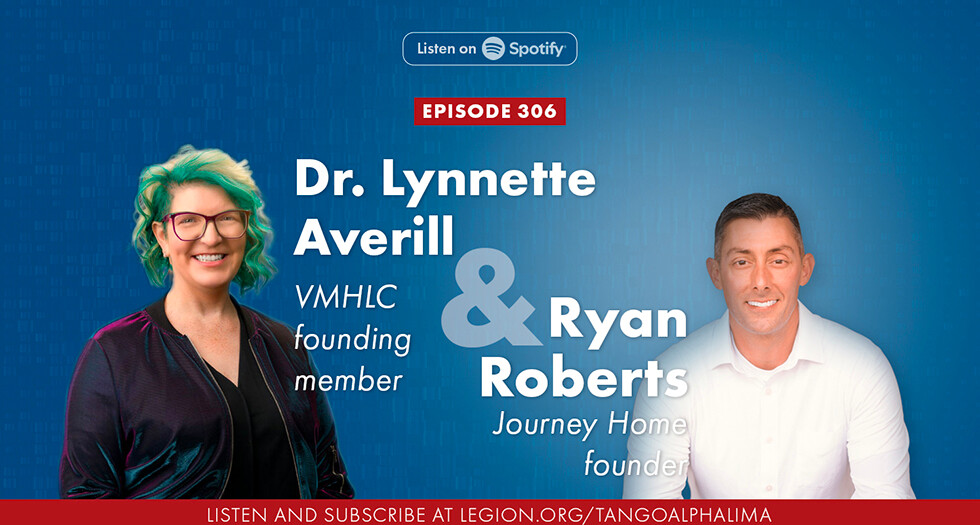
Marine combat veteran Ryan Roberts and Dr. Lynette Averill, trauma scientist at Baylor College of Medicine, explain why moral injury is not a variant of PTSD in this episode of Tango Alpha Lima.
Ryan Roberts was a 19-year-old Marine in the battle of Nasiriyah, Iraq, on March 23, 2023. Within hours, 18 of his comrades from 1st Battalion, 2nd Marines, were killed, including some by friendly fire.
His job was to go into the burned-out vehicles and collect their remains.
"I remember thinking to myself, ‘Well, this is the worst of it,’" Roberts recalls in this week’s episode of Tango Alpha Lima, The American Legion's podcast for servicemembers, veterans and military supporters. "This is the worst I can possibly experience."
He was wrong.
Within 24 hours, his fire team disabled a vehicle barreling through their checkpoint. They found two armed military-age males in the front. When Roberts opened the back door, he found two children, aged four and six.
"I went there to protect the innocent," he says. "And in doing the right thing, making the right call, it resulted in a circumstance where I violated that core value."
That moment, he says, was the beginning of a wound that would take nearly two decades to identify.
Roberts spent 17 years cycling through the VA and private mental healthcare, accumulating diagnoses for PTSD, depression and more than a dozen mild traumatic brain injuries. But there was a deeper fracture in meaning, identity and purpose that no treatment could heal.
"No one said the words 'moral injury,'" he said. "No one touched on meaning, on purpose, on connection, on relationship. Everything was viewed through the lens of pathology."
On this week's episode, Roberts is joined by Dr. Lynette Averill, a trauma scientist at Baylor College of Medicine and one of the nation's leading researchers on psychedelic-assisted therapy for veterans. They explain what moral injury is and how it is not simply a variant of PTSD. Instead, moral injury is a categorically different wound.
The healthcare system, for all its advances, has been largely missing it as Averill knows all too well.
Averill’s father, a Marine who served in Vietnam, died by suicide after years of ineffective treatment. She grew up in rural Montana, watching her mother ask VA representatives whether there were resources for families and kids. There mostly weren't.
"There is that little girl piece of me in the back of my brain," she says, "that does this work because I really want other kids to grow up with their parents."
The distinction she and Roberts draw between PTSD and moral injury matters enormously for how veterans are treated. The common interventions for PTSD help a person tolerate, habituate and reframe. But moral injury, as Roberts came to understand it, isn't rooted in fear. It's rooted in a violation of values.
"You cannot cognitively restructure your way out of a moral injury," Averill says. "You cannot say, 'Well, this thing that at my core I believe is what it means to be a good person, but I violated that. Well, it's fine, I'll just shift my belief system.' That's not how that works."
For Roberts, the collapse was progressive and largely invisible. On paper, his PTSD scores were improving. His career was flourishing as he rose to a senior executive role overseeing clinical research in academic medicine. But at home, it was a different story.
"I was at the birth of my children and I couldn't feel anything," he says. "I was at my wedding and I don't feel what I'm supposed to feel. I'm moving through my life like I'm an actor in some show. It's just going from one mask to another. And it was exhausting."
By 2019, suicidal ideation was constant for Roberts. After a second attempt on his life, he flew to Mexico on "a Hail Mary." He participated in an ibogaine and 5-MeO-DMT program at The Mission Within.
During one phase of the medicine, with his ego quieted and fear temporarily lifted, he was able to view his past experiences differently. He saw them the way you'd look at stars in a constellation with each event connected to another, forming a pattern that had always been there but impossible to see.
"Everything had a purpose, everything had a meaning," he says. "And to the depth that I've understood suffering, I now understand joy. I almost think of it like I'm a vase that trauma carved really deeply. Now I've got this deep vessel I can fill."
He has spent the five years since building The Journey Home, a peer-led moral restoration program grounded in the conviction that what is wounded in relationship can only be restored in relationship.
Averill, who recently left the VA, now leads the STARLIGHT trial, one of the first psilocybin-assisted therapy studies for PTSD in the country, funded by landmark Texas legislation she helped shepherd into law.
Both see the same gap in the system: veterans are being stabilized, their crises managed and then discharged. The deeper work of restoring meaning, purpose and belonging is left undone.
"I get people stabilized and we kind of say, 'Check, we're done,'" Averill says. "But there's so much more need and so much more opportunity to support people beyond that."
Also, Tango Alpha Lima hosts Stacy Pearsall, Adam Marr and Joe Worley discuss:
• Weigh in on the new DoD mandatory zero visible mold policy.
• Praise those who take care of veterans and servicemembers in honor of Military Caregiver Month.
• Discuss resources available for caregivers.
Don’t miss this inspiring conversation. Subscribe to the Tango Alpha Lima Podcast on Spotify, YouTube, Apple Podcasts, or wherever you listen. Join a community that celebrates authentic veteran stories and proves that service is a lifelong commitment.
Your stories. Your service. Your community. This is Tango Alpha Lima.
- Tango Alpha Lima