

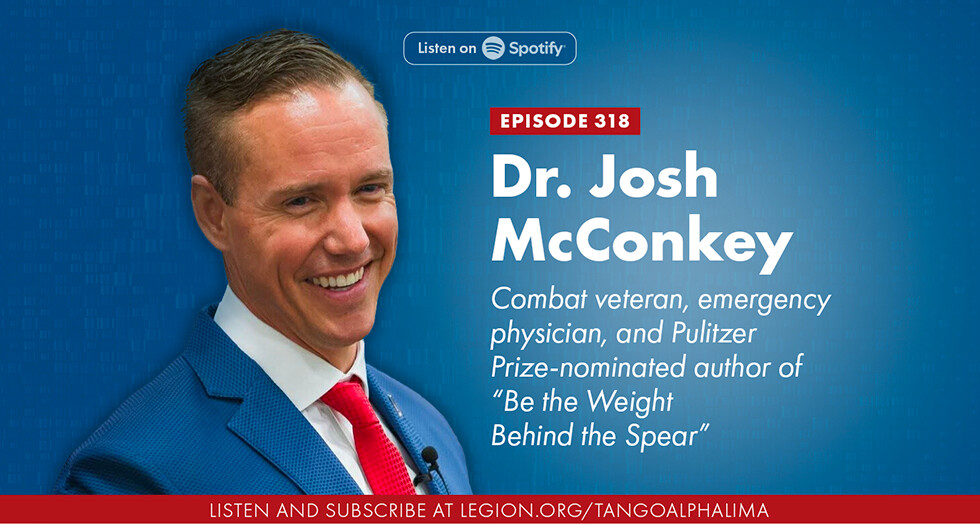
Air Force veteran Dr. Josh McConkey joins the Tango Alpha Lima podcast to share lessons learned in Iraq and as an emergency physician that inspired his authoring leadership-driven books.
Within two weeks of Dr. Josh McConkey deploying to Iraq in early 2007 as a flight surgeon, eight helicopters were shot down, a flight surgeon was killed, and the life he knew was no longer.
“There was a very real chance I wasn't going to make it home. You have that innate you do want to survive, and so you adapt very quickly,” he said. “Once you just let go of that fear of death, and it's not that you don't care, it's just you have to get things done and people need you.”
McConkey is this week’s special guest on the Tango Alpha Lima podcast where he shares stories about his time as a combat flight surgeon, Air Force Reserve colonel and emergency physician that resulted in him authoring the leadership book “Be the Weight Behind the Spear.” The idea is that those at the tip of the spear never succeed alone. Behind them stand families, teachers, coaches, mentors, medical professionals, fellow servicemembers and communities.
“You have to have a strong weight behind you,” McConkey said. “At some point in your life, you're going to have to figure it out that you do need other people and that putting that time and investment in your friends and your family and your spouse and just colleagues at work, just build that support structure around you because life is crazy, life is hard.”
McConkey grew up in Alliance, Neb., where he played American Legion Baseball and attended Nebraska Boys State before being the first one in his family of railroaders to attend college. “I broke the mold and could not be contained,” he said. His direct commission into the Nebraska Army National Guard Medical Service Corps in 2000 was inspired by the men and women who served before him and listening to “crazy” stories at the dinner table of his stepmother’s time as an emergency room nurse.
Then Sept. 11, 2001, changed everything. He went from thinking he would be traveling the world to the battlefield.
“Just that combat time alone, I learned very quickly that nobody cares how big your house is and what kind of car you drive, you know, just how much money you make, none of that matters,” McConkey said. “It's, you know, these are men and women dying for their country and you're picking up body bags ... when I wake up in the morning, that's the first thing I think about. Those men and women that didn't make it home.”
That motivation for living life for those who can’t is what drives McConkey to use his book as a call to action.
“Every American has a gift. Whether that's coaching, teaching, volunteering, getting involved with churches and schools, there's so many organizations, animal shelters, veterans organizations, there's so many organizations that need you,” he said. “You need to get out in your community and make that difference. So reading the book, I hope it energizes people and lets them realize that they matter, that what they do every single day matters.”
McConkey was also inspired to write the book based on what he saw in the ER – a generational gap of youth living in a digital world that was creating anxiety, depression and suicidal thoughts and a lack of skills like communication, leadership, resiliency and direct eye contact.
“I wrote the book to try to do something to fix the problem because this is everybody’s problem,” he said.
McConkey also dives into:
· How his transition from taking care of men and women in combat to the civilian emergency room was difficult and resulted in him and his wife leaving the United States for a few years.
· A proud moment of training his Critical Care Air Transport Teams who were then ready and “performed amazingly” for the Israeli-Hamas conflict.
· His favorite picture that features his crew chief whom he babysat as a kid.
· Books he wrote to help youth with leadership skills and perseverance.
The final thoughts McConkey leaves listeners with is that “you’re not alone” when it comes to mental health. “As an emergency doctor, I always kind of put that out there, we're here for you. You don't have to carry that yourself. Everybody has a breaking point. Your emergency department is always there for you.”
Also in this episode, co-hosts Stacy Pearsall, Adam Marr and Joe Worley discuss:
· A July 2026 report from the Government Accountability Office identified four important questions on quality care.
· The restructuring of Air Force medicine to concentrate on preparing medical personnel for operational missions, integrating medical capabilities with combat units and caring for airmen, guardians and their family.
Subscribe to Tango Alpha Lima on Spotify, Apple Podcasts, YouTube, or wherever you listen.
Your stories. Your service. Your community. This is Tango Alpha Lima.
- Tango Alpha Lima