

Grand opening on nation’s 250th anniversary serves as ‘a call to action’ for future generations.
American Legion National Commander Dan K. Wiley had many choices about where and how to celebrate the nation’s 250th anniversary. Since the beginning of his term as leader of the nation’s largest organization of U.S. military veterans, he never wavered about his desired destination for July 4, 2026.
Somewhere near Medora, N.D., was where he wanted to be, in the rugged country where a 25-year-old Theodore Roosevelt arrived from New York in 1884 to raise cattle and to heal from the grief of losing his wife and mother on the same day earlier that year. If not for his time in Dakota Territory, he later said, he would never have been the 26th President of the United States. Moreover, his experiences among hardworking stock growers, their families and the communities they shaped helped make him a symbol of American courage, integrity and strength to embrace a tough landscape while at the same time serving the common good.
And so, the Fourth of July 2026 would find Wiley – a U.S. Air Force veteran, cattle grower and public servant throughout his life – standing on a pedestal atop a butte overlooking Medora on the edge of the North Dakota Badlands. Ceremonies to officially open the new 96,000-square-foot Theodore Roosevelt Presidential Library and Museum, with its dazzling mix of advanced technology, immersive exhibits, art, panels and artifacts, began promptly at 10:27 a.m. (Roosevelt’s birthday was Oct. 27).
At exactly that time, Wiley and American Legion Department of North Dakota Commander Jason Anderson, also an Air Force veteran, squinted up the hill from their place near the earth-toned structure that blends unobtrusively into landscape.
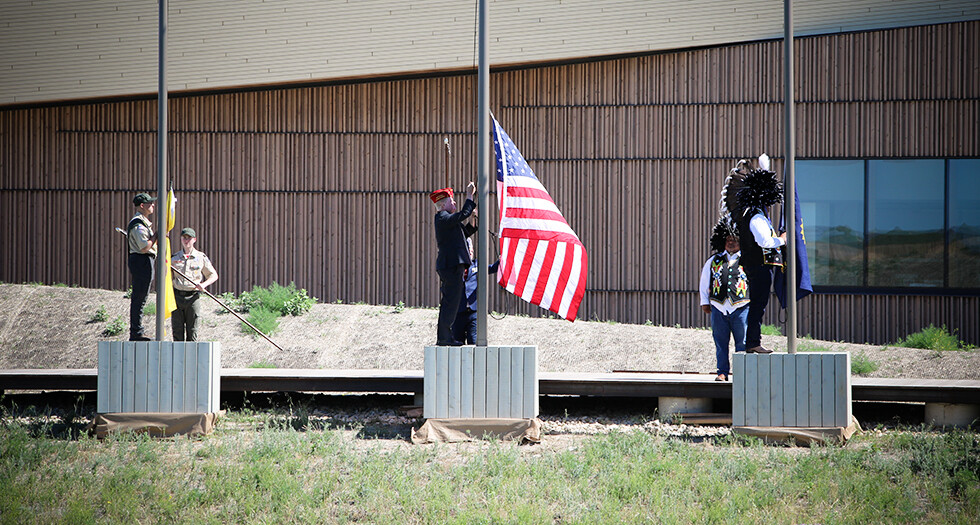
A phalanx of horsemen in uniforms to match Theodore Roosevelt’s famed “Rough Riders” of the Spanish-American War appeared on the horizon. Led by one adorned as Roosevelt himself when he was the lieutenant colonel who later earned the Medal of Honor for having led the 1st Volunteer Cavalry Regiment in Cuba during the Spanish-American War, the re-enactors charged over the prairie grass toward Wiley and Anderson. Thousands of ticketed onlookers stood in awe, their smartphones held high to record the moment, as the U.S. flag was delivered.
The national commander from Kansas and the department commander who also serves as mayor of Scranton, N.D., snatched the flag from one of the horseback riders, attached it to the halyard of the middle and tallest pole and hoisted it skyward. It billowed against a vibrant blue sky, and the national anthem quickly filled the morning air.
“It was an amazing event – a once-in-a-lifetime thing to be able to do, and participate in,” said Anderson, who grew up just down the highway from Medora. “The pride we show every day is just multiplied with the crowd here, the experience itself, (it) was truly an amazing thing. A humbling thing, too.”
“It’s always an honor, first and foremost, to honor our flag and honor our country when you have the opportunity to do that,” Wiley said after the ceremony. “But really, to represent The American Legion … to be the organization that raises the flag for the first time at a presidential museum and, of course, the Presidential Library and Museum of Theodore Roosevelt, whose family is so well-connected with The American Legion and has been a supporter of The American Legion all 107 years of our existence, I think that is such an honor. I had an opportunity to meet those family members today. I think it’s just important for The American Legion that we were here today.”
Theodore Roosevelt Jr. was one of four World War I officers who met in January 1919 and planted the seed for what would become The American Legion two months later in Paris. Prior to that, former President Theodore Roosevelt and Gen. Leonard Wood operated preparedness camps across the country that launched American Legion, Inc., a national network of volunteers willing to train and fight if the United States were to enter World War I. All of the former president’s children ultimately served in one capacity or another during World War I, and Roosevelt Jr. was a decorated combat officer, who later made World War II history at age 56 when he received the Medal of Honor for his valor at Utah Beach on June 6, 1944 – D-Day.
The Medals of Honor of Roosevelt and Roosevelt Jr. are proudly displayed side by side inside the museum.
STORY CONTINUES BELOW
The dedication ceremony was an orchestra of words, music, tribal dance and praise not only for what President Roosevelt did, but for what he would ultimately mean to the nation and its ever-evolving future.
A drone from the Grand Forks Air Force base soared overhead. The land was blessed by the Mandan, Hidatsa and Arikara (MHA) Nation. North Dakota Gov. Kelly Armstrong spoke of the importance of the moment and the journey the project had been on since ground was broken in 2024. North Dakota U.S. Sens. John Hoeven and Kevin Cramer applauded all that had gone into turning the library’s vision into reality.
Ted Roosevelt V, great-great grandson of the president, told the crowd on behalf of the family, “that there is an unspoken truth about this library … it never should have happened. The idea was just too large, too audacious, too improbable.”
He said the library is now open “because thousands of people committed themselves to an idea that initially seemed impossible. We are here because of providence, yes. But also because of the work, generosity, imagination, persistence and faith of so many people.”
Roosevelt V made the point that “this library is not about him. It’s about you. If you leave here with nothing more than a better understanding of Theodore Roosevelt, then we will have failed … a much less expensive book would have sufficed. This is not a shrine to Theodore Roosevelt. It is a place to come face to face with history, with one another, and with the natural world.”
The natural world is integral to the site and its mission.
“This isn’t just landscaping,” Jenn Carroll, manager of sustainability for the library, told the crowd. “It’s a hand-planted, working ecosystem. Every grass, flower and pollinator plays a role in bringing this prairie back to life, creating habitat for wildlife and restoring one of North America’s most endangered landscapes.”
Her husband, retired Army Lt. Col. Clarence Carroll III, past American Legion Department of North Dakota commander, says that “when this building is certified, this will be the most ecological building on the planet. It’s going to give the grid more electricity than it uses. Every single piece of this building is recyclable.”
Moreover, it matches Roosevelt’s passion for bold measures and responsible citizenship. “Arguably, Theodore Roosevelt was the most dynamic president we’ve ever had,” the retiree of 32 years on active duty said. “To be able to build an incredible treasure like this and to be a part of it since day one, with my wife being in charge of sustainability … just to see this come alive from a groundbreaking adventure, it brings tears to your eyes. There is nothing like this in the world.”
“When you go through it and you look at the things that Theodore Roosevelt stood for, it’s really a call to action to people,” Wiley said. “The question that is one to be answered is, ‘What are you going to do to make a difference in this world? What can you do?’ When I go through this, I think, ‘What more can I do to make this world better?’
“When you stop and think about President Theodore Roosevelt – you can almost say, ‘What didn’t he do in his lifetime?’ He served in the military. He ended up being a Medal of Honor recipient. In fact, he and his son are one of only two father-son tandems to receive the Medal of Honor. His family was committed to public service. His son Quentin died in combat in World War I. He oversaw the construction of the Panama Canal. He ascended to the presidency and was one of the most transformative presidents that we’ve had … (He) set aside so many hundreds of thousands of acres for national parks and national monuments to be preserved for future generations.
“Of course, he believed in public service. He (also) believed in being that person in the arena that gets bruised and bloodied and not being on the outside. One of the quotes I saw in the library, and I will paraphrase it, was that when you make a decision, the best thing you can do is make the correct and right decision. The worst thing you can do is do nothing. Life is about those that go out there and do things, not those that sit back and do nothing. That’s really what his call is, for people to get involved in public service and go out and make a difference in this world.”
“Theodore Roosevelt did not believe in small citizenship,” Roosevelt V said. “He understood that the health of our democracy depends not only on its leaders but on the character of its people. He understood that conservation is not merely about saving beautiful places. It’s about stewardship, recognizing that we hold the land, the water and the country itself in trust for generations we will never meet. It was here amid the hard beauty of the North Dakota Badlands that those convictions were forged.”
Roosevelt carried the lessons he learned from ranching near Medora all the way to the White House, Roosevelt V said, adding emphatically that the library and museum stands on land that for centuries was the ancestral home of the MHA people. “We are deeply grateful for our partnership with the MHA Nation and for the generosity, wisdom and living traditions that they bring to this institution. A library devoted to leadership and citizenship must tell the truth about the land on which it stands. It must honor those who cared for it across generations. It must recognize that the story of this place did not begin with Theodore Roosevelt, nor does it belong to any one family or institution. This land and the wisdom it has yielded belongs to all who shaped it, cared for it and called it home.”
Wiley described the Dakotas and the Great Plains states, and the people who live there, as “the backbone of our country.”
And the town of Medora, at the gateway to the Theodore Roosevelt National Park, “reflects the fabric of our country … a small community where there’s a lot of obvious pride. You see the pride here in this library because, as you walk through this library, No. 1, it’s very kid-friendly, very interactive. But this library is also for future generations … to learn the value of those things that Theodore Roosevelt valued: a call to service, public service, and I think that’s important for the future generations to understand.”
The importance of the library for young people – and the opportunity it presents for civics education – were among the reasons the American Legion Department of North Dakota passed a resolution of support for the Theodore Roosevelt Presidential Library and Museum a week before the July 4 dedication.
Anderson and Wiley presented CEO Ed O’Keefe with a specially designed version of the resolution after Saturday’s event. “We’ll get lots of folks here,” the department commander told O’Keefe when presenting it to him.
“It’s going to be a fantastic opportunity for the schools once they get back in session and start making their trips here,” he said. “Younger folks coming in behind us, trying to figure out their place in life, maybe some of them will get interested in not only military opportunities, but just civics in general. There’s lots to be gained from an organization like this, and surroundings like this, that will hopefully inspire a next generation of individuals to serve.”
That was the long-term vision of President Roosevelt, his great-great grandson told the crowd. “His legacy belongs to every American, in anyone who believes in the promise of this country – that citizenship matters, that leadership matters, that preservation of our natural resources matters, and that the work of building a more worthy nation belongs to all of us.
“Theodore Roosevelt’s life should not make us nostalgic for a more heroic past. It should make us more determined to build a working future. That is the aspiration of this library. It is a call to action to remind every child, every family and every citizen who walks through these doors that history is not finished and that each of us has a role in writing what comes next.”
- USA250