

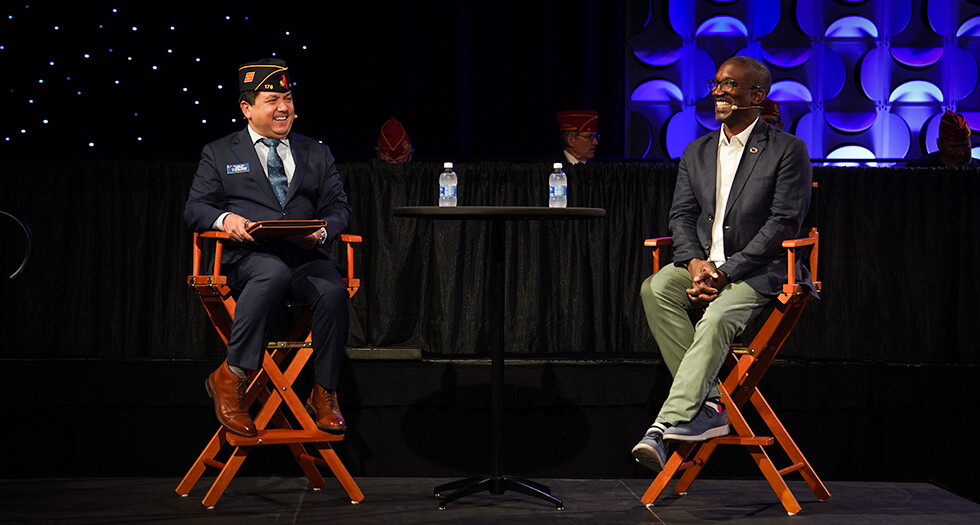
Oracle Health’s Dr. James Ellzy discusses the Electronic Health Record deployment, which links DoD and VA health records for servicemembers and veterans.
The goal of the Federal Electronic Health Record (EHR) system – the software that stores health information and tracks all aspects of patient care – is to connect U.S. Department of Veterans Affairs medical facilities with the U.S. Department of Defense (DoD), U.S. Coast Guard, National Oceanic and Atmospheric Administration (NOAA) and participating community care providers. When implemented, the EHR will allow clinicians to easily access a veteran’s full medical history in one location.
So far, the EHR has been rolled out at multiple VA medical centers in Michigan, Ohio, Kentucky and, most recently, Indiana. It’s also in use at 26 associated clinics and 104 remote services, such as VA call centers and clinical resource hubs.
On stage during The American Legion National Convention in Louisville, Ky., National Commander Dan K. Wiley admitted that implementation of the EHR “has been a slow process. It has been an issue of importance to The American Legion and the veteran community for decades.”
To provide an update to Legionnaires about the project, the convention stage played host to a fireside chat to update the audience on EHR’s deployment. American Legion Veterans Affairs & Rehabilitation Division Director William Call Jr. talked with Dr. James Ellzy, Vice President Federal Health Executive and Market Lead for Oracle, which has designed the EHR system.
Ellzy kicked off the discussion with a brief explanation of what EHR will provide. “It’s about the problems that you come in and talk to (healthcare providers) about, but it’s also what that plan of care is,” he said. “It’s where your medications are tracked. It’s where your lab results, your X-rays, all of that health information (are) in one spot electronically.”
Ellzy said Congress has long wanted one medical record between VA and DoD, and that many previous attempts have fallen short in linking what he said is the largest health record in the world.
“Now is the opportunity that from the time you come through (a Military Entrance Processing Station) through all of your active-duty time and onto the VA … it’s one seamless record,” Ellzy said. “I like to think of it this way: There’s one big electronic health record with DoD facilities charted, VA facilities, Coast Guard facilities and NOAA facilities all charted in the same health record system.
“So as a patient, no matter which of those four organizations is charting your healthcare, documenting your healthcare, they’re documenting it on the same record that currently sits in Kansas City.”
Call asked how EHR will help both veterans and transitioning servicemembers into that space. “As you think about transitioning from active duty to going to VA – which all of us in this room have done – you went to the VA and they said, ‘Who are you? What’s your history?’” Ellzy said. “They knew nothing about you when you got there. So imagine that world when you come in and they have all the stuff that happened while you were on active duty automatically, because it’s part of the same record. There’s no starting from ground zero and having to pull up the papers.”
Ellzy said as EHR rolls out at new facilities, veterans using those facilities will have limited online access, such as making appointments and getting prescriptions refilled.
“You’ll still be able to do it at the facility,” Ellzy said. “This is a huge change for the clinicians at VA. They have to go through training and work as a team to make sure that they take good, perfect care of the veterans that come in. So with that, they have some decreased time in their clinic availability so they could actually do the training they need to do.
“And then after going live, it takes about a month for them to get fully back up to where they were before with a system they’ve been using for 20 years.”
Ellzy asked Legionnaires who use VA medical facilities to check when theirs will be switching to EHR. “And as the transition goes, if there are problems or issues, make sure that your leadership knows,” he said. “We meet with your leadership on a quarterly basis face to face. Let us know if there are any issues so we can deal with them.”
- Veterans Benefits