

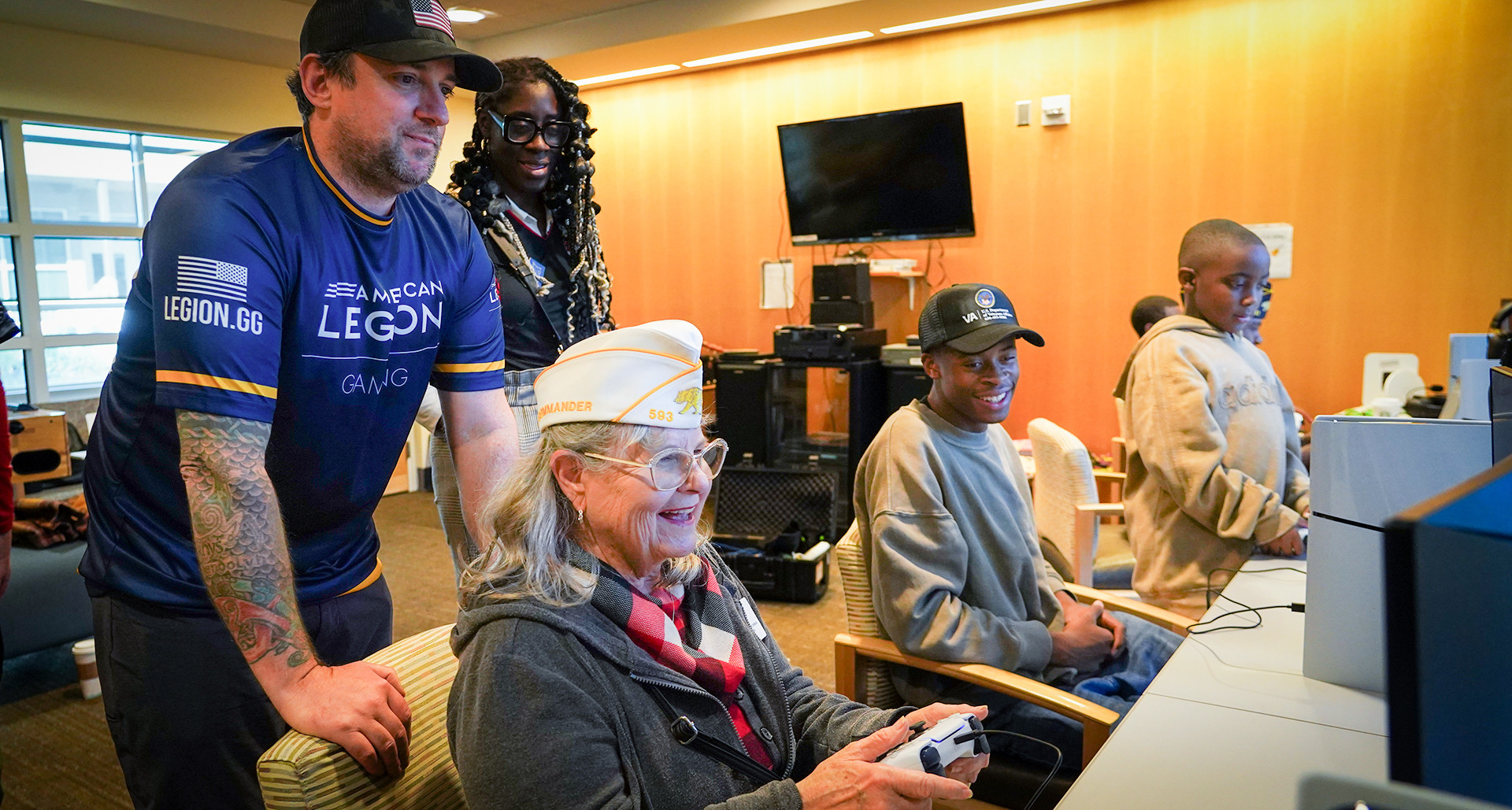
American Legion Gaming, Palisades Post 283 use American Legion Auxiliary grant to provide gaming stations for veterans in VA recovery unit.
U.S. Army veteran Peter Oraha currently is a patient in the Palo Alto VA Medical’s Foundations of Recovery unit, the facility’s substance use disorder (SUD) residential program. He admits that he struggles with the program at times, but a recent gesture by members of The American Legion Department of California will make things a bit easier for the veteran.
Palisades Post 283 and its American Legion Auxiliary unit recently collaborated with American Legion Gaming (ALG) to provide four gaming stations for the SUD unit. Oraha said the donation has him “stoked” and will assist in his efforts to treat his addition.
“It’s going to definitely make a big difference,” said Oraha, who served in the Army from June 2009 to December 2012. “It’s going to make me happier while I’m here. Definitely going to make me want to stay here. It seems to be like any little thing will make me want to leave here. Although I’m trying to help myself, it seems very difficult to be in an environment that’s high-stress. This just makes it a lot easier.”
Oraha said the gaming setups also will help bring together veterans going through the treatment program. “There’s a lot of us who sit in our rooms. We’re used to that on our deployments,” he said. “We sit in our rooms. We game, watch movies and stuff like that. This will definitely get us outside our rooms and socializing. This will make me social.”
The gaming stations came courtesy of a $10,000 National American Legion Auxiliary Foundation Grant applied for by Unit 283. Half of the grant went toward providing the gaming stations to the Palo Alto VAMC, while half was used to fund similar setups delivered Nov. 10 to the New Directions for Veterans unit at the West Los Angeles VA campus to offer recreation, connection and stress relief for veterans participating in recovery programs.
Each gaming station includes a 34-inch curved gaming monitor, a PlayStation 5 and a gaming headset – “Everything that you would need to start up a team,” said Post 283 Adjutant and ALG CEO Jared Morgan. “The goal here is to get veterans in Palo Alto to play games with veterans in Los Angeles and then connect them to the greater network that we’ve created, made up of 10,000 veterans and servicemembers on (social platform) Discord.
“We think that gaming is a great way – and the VA agrees – for veterans to come together with like-minded people. That’s what this is all about. We’re all about connecting veterans who may feel isolated. The holidays are coming up. Especially veterans who are going through recovery, this is a time where they could feel extremely isolated and even abandoned. We want The American Legion to be there for them … and American Legion Gaming is here to bring them video games and bring them into the community, bring them into the family.”
Foundations of Recovery Recreation Specialist Antone Fernandez IV has been incorporating gaming for patients since 2020 through Dungeons and Dragons and Magic: The Gathering but wanted to expand to electronic gaming.
“It helps with socialization skills,” Fernandez said. “If people aren’t coming out of their rooms, sometimes gaming is an excuse to get them out of their room. It’s a very social engagement, whether you’re a one-versus-one player or if you’re in a team.
“It can be making new friends or strengthening bonds with friends they’ve already had. It some cases it can be a new form of socialization.”
Fernandez already has developed a strategy for using the gaming stations. “I’ll try to start small,” he said. “One, just developing or strengthening relationships with fellow veterans and their peers in this unit. Hopefully connect with other veterans at other (VA facilities). And when they leave here, hopefully they take those friendships they have made and the skills they’ve learned and keep them in … new circles. Better circles.”
Auxiliary Unit 283 First Vice President Nekishia Lester-Spinner said it’s her organization’s mission to support veterans, “especially their social and mental well-being. One of the things we have learned is that video games are one of the things that help veterans in terms of being able to deal with stress, deal with emotional issues and also have fun.
“It’s service. That’s the very foundation of our organization. We do it because we know it’s just what we need to do. To me, this is the least I can do.”
On hand for the delivery and set-up of the gaming stations was California Area 2 Vice Commander Lois Flint, who oversees 60 posts across six districts. A member of Prunedale Post 593 in Salinas, she said the game stations can help keep that connection veterans feel with one another.
“I am a Marine and served a long time ago. But I still have connections with the ladies that were in my platoon and went to school with me and were stationed with me at Camp Pendleton,” Flint said. “That comradeship, that togetherness, that shared experience means a lot to us. Others do not understand. So, we need to support each other.
Flint hopes to bring a similar program to other California veterans. “Everybody’s gaming, but this allows them to game together, not in solitude. We need the togetherness. Comrades need to be with people,” she said. “They need this in rehab. They need something to do besides watch TV.”
Morgan believes the donations to both VA facilities will have a lasting impact.
“It’s all about connection. It’s about camaraderie. And it’s about showing people that The American Legion is relevant, it’s a forward-thinking organization, and we’re in the video game space and here to stay,” he said. “We’re working to bridge this gap. We’re bringing these veterans together through video games, and we’re hoping that they can use this as a sort of therapeutic tool for the things that they’re working through in their lives.”
- Veterans Healthcare