

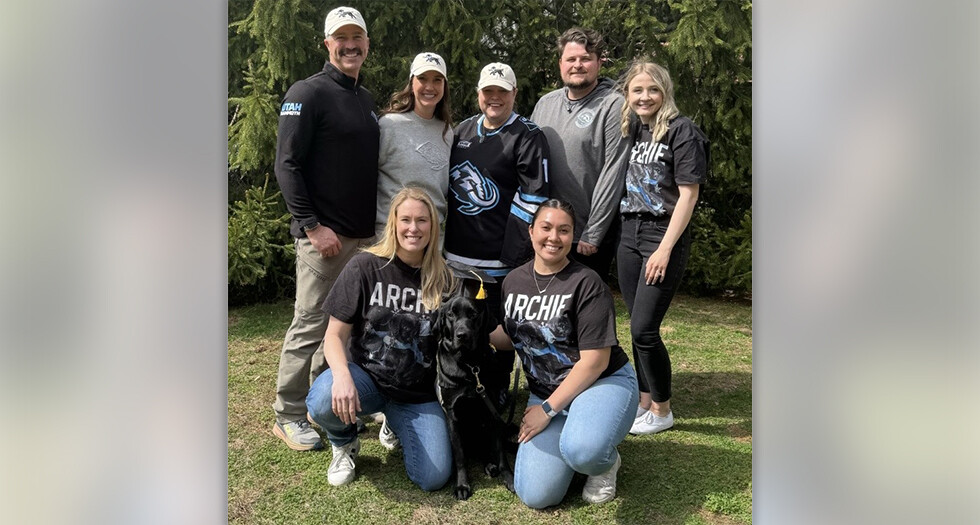
U.S. Air Guard National veteran and past Department of Utah commander shares how Archie gave her hope – and so much more.
National Service Dog Day falls on Sept. 20 and is designed to honor the role of service dogs in the lives of people with disabilities and America's veterans. The day was designated by Congress in 2023 and is part of September’s National Service Dog Month.
We asked you to share how your service dog has impacted your life, so we can share your story with others. Today we are publishing the second in that series and will continue to do so ahead of and throughout September.
You can still share your stories – and photos of you with your dog – one of two ways:
Email sbrooks@legion.org.
Submit your story and photo on www.legiontown.org in the “Why I Love My Service Animal” section.
Our first in the series is from U.S. Air National Guard veteran and Past Department of Utah Commander Ninzel Rasmuson, a dual member of American Legion Post and Auxiliary Unit 140 in Riverton. The Paid-Up-For-Life member of both organizations shares her story of her service dog Archie, who she refers to as “more than pet and a leash.”
The moment I learned Archie was going to be my service dog, I cried with tears of joy.
After more than three and a half years of gaining courage, hoping, navigating the process, and wondering if I deserved a service dog, suddenly there was a name.
Archie.
A black Labrador from America’s VetDogs and named after National Arches Park in Utah, Archie had already captured hearts through his special connection with the NHL team, Utah Mammoth, and America First Credit Union, as a “Puppy with a Purpose.” I had watched his journey without knowing that one day his journey and mine would become one.
Learning that Archie would be my service dog represented something I had not allowed myself to fully imagine.
Hope.
I served in the Air National Guard from 1989 to 2001. I learned to accomplish the mission, take care of others and keep moving forward. Those lessons stayed with me long after I took off the uniform.
But so did other things.
I live with CPTSD (complex post-traumatic stress disorder). Like many veterans carrying invisible wounds, I became very good at appearing strong while privately navigating challenges most people could not see.
I built a life centered on service. I became a servant leader, advocate, nonprofit founder and Legionnaire. I dedicated myself to helping veterans, military families, first responders\ and others who needed someone in their corner.
I became very good at being the person everyone else could depend on.
Learning that I could need help, too, was much harder.
Before Archie, an ordinary activity could require extraordinary preparation.
Entering a crowded room meant automatically scanning everything around me.
Where are the exits?
Who is behind me?
Is someone standing too close?
Where can I sit so I feel safe?
Can I leave quickly if I need to?
Most people never knew those questions were constantly running through my mind.
That is the reality of many invisible wounds. Someone can stand at a podium, lead an organization, travel across the country, advocate for others, smile for a photograph, and still be fighting a battle no one else can see.
Strength and struggle can exist in the same person.
My three-and-a-half year journey toward receiving a service dog forced me to confront something that did not come naturally: allowing myself to receive the same kind of support I had spent years providing to others.
Then came Archie, and with him, the next step of that journey at America’s VetDogs.
Arriving for training was both exciting and overwhelming. Being in a new environment, adjusting to a structured schedule, and learning how to work with a highly trained service dog challenged me in ways I had not fully anticipated. There were moments when I questioned whether I could do it, whether I was ready, and whether I deserved this kind of support.
But I was not alone.
During my service dog handlers training in Long Island, N.Y., I was surrounded by other veterans and first responders who were also being matched with their dogs. Each of us carried our own stories, our own invisible wounds, and our own reasons for being there. Despite our different backgrounds, there was an unspoken understanding among us, a shared recognition of what it took to ask for help and to show up for this process. We encouraged one another through difficult moments, celebrated small victories, and witnessed each other’s growth. That sense of community became an important part of the experience, reminding me that healing does not happen in isolation.
Archie’s puppy raiser had already given him a strong foundation of love, discipline and trust. That early investment showed in everything he did and made it possible for us to begin building our partnership.
The staff at America’s VetDogs were equally extraordinary. Their patience, encouragement and expertise guided me through each step of the process. They understood not only how to train service dogs, but how to support veterans navigating invisible wounds. They met me where I was, helped me work through challenges, and reminded me that learning to receive help is part of healing.
What began as a challenging experience became a transformative one.
Archie cannot change what happened to me, and I would never expect him to.
What he can do is help change how I experience today.
His presence provides grounding and reassurance. He can help create space around me when I need it and provide a steady, trained presence when my surroundings become overwhelming. Knowing he is beside me gives me greater confidence to enter environments that once required tremendous emotional preparation.
For someone living with CPTSD, trust can be complicated.
That may be one of the greatest gifts Archie gives me.
Trust.
Our partnership requires it every day. Archie trusts me to guide, protect and care for him. I trust him to use his training to support me when I need him, sometimes in moments when others may not even realize I am struggling.
His impact also reaches beyond me.
People notice Archie. Veterans stop to talk. Children smile. Strangers ask questions. Those encounters open conversations about service dogs, veterans, CPTSD and invisible disabilities.
If sharing part of my story helps another veteran realize that asking for help is an act of courage, then Archie and I are serving together.
For years, I have said that service changes and saves lives.
I have spent much of my life trying to live those words for others.
Now I understand them from the other side.
After more than three and a half years, there came a moment when I held Archie’s leash in my hand for the first time.
To someone watching, it might have looked ordinary.
A woman.
A black Labrador.
A pet.
A leash between them.
But I knew what was really at the other end of that leash.
A journey through trauma and healing.
Trust I thought might never fully return.
Greater independence.
A sense of safety.
And hope for what comes next.
I thought I was simply taking hold of Archie’s leash.
Instead, I realized I was taking hold of something much bigger.
My life.
Archie does not define my story by what happened to me. He is helping me write what comes next.
And now, we move forward together, one day and one paw at a time.
- Veterans Healthcare