

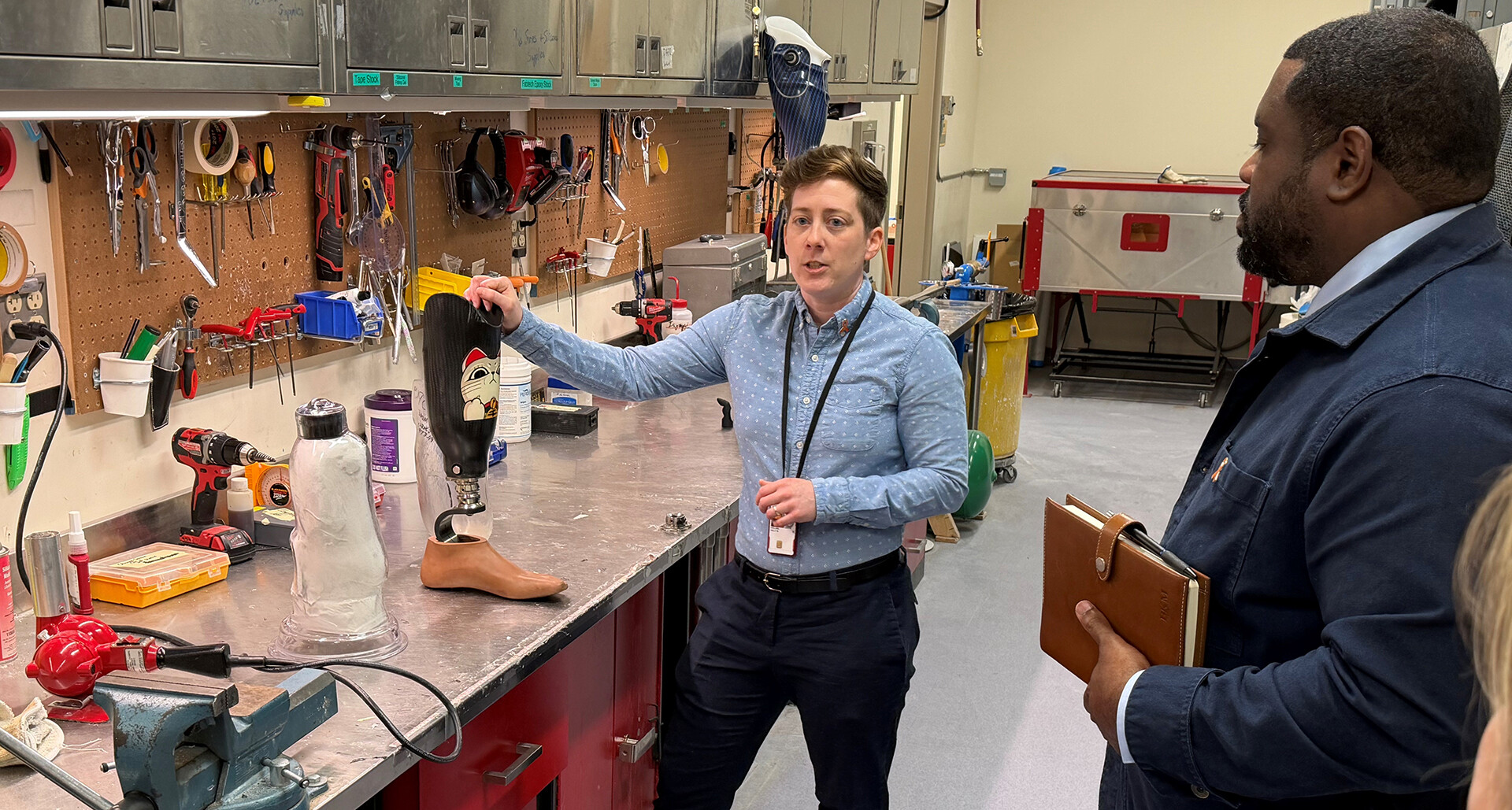
Veteran shares his success story during American Legion System Worth Saving visit to the VA Puget Sound Health Care System.
The VA Puget Sound Health Care System’s (VAPSHCS) amputation, prosthesis and rehabilitation program has around 1,000 patients with a major amputation – when the entire hand or foot is lost.
During its System Worth Saving visit to VAPSHCS in Seattle, Wash., on April 30, American Legion national staff were given an overview of the program. But perhaps more impactful, staff was given an opportunity to meet one of the beneficiaries of the medical center’s care.
Bob Jensen, who served in the U.S. Navy from 1982 to 1989 and now owns a sports bar in Orting, underwent a lower leg amputation in June 2025 after dealing with vascular issues that resulted in four hospital stays and six different surgeries prior to the amputation.
Jensen underwent rehabilitation at the center’s Community Living Center until August and then moved back to his home in Tacoma, where he stayed on the first floor for the next two and a half months. He’s continued to undergo physical therapy, work that has paid off immensely.
Jensen now drives himself, attends Seattle Seahawks and Mariners games, and recently went on a cruise in Florida – without taking a wheelchair, crutches or any other walking support. He hasn’t used a wheelchair since last December.
While the American Lake VA Medical Center at Joint Base Lewis-McChord is closer to his home, Jensen chooses to drive to Seattle for his care. “It’s because of this team,” he said. “(Regional Amputee Medical Director Rebecca Speckman, Prosthetics Lab Chief Kelly Walling and Amputee Rehabilitation Coordinator Christina Frankel-Barton) are a better fit for me. Not that the people at American Lake aren’t qualified. But being here, It’s helped me not survive but thrive. This group has done that. It’s that push to not just survive, but how can you thrive?”
Speckman said Jensen is very active in the center’s various amputee support groups and is on deck to become a peer support specialist. Jensen is doing so to assist others by sharing his own experience. “Sometimes you get the real information from other folks who are in the s--t with you, going through the same thing,” he said. “That’s why the connection with people is important.”
Success stories like Jensen’s drive Speckman.
“It’s the whole reason I do this job,” she said. “I recognize that so much of what we do is so impactful and important to vets. When we have those kinds of successes, and you know you’ve led them back to a place where things are important to them, that’s the whole reason we want to do therapy. That’s why I enjoy being at VA. We don’t just get people back walking with the prosthesis. We get them doing the things that are important to them.”
Jensen has nothing but the highest praise for VAPSHCS’s staff. Calling himself a “passive” social media user, Jensen said that amputee support groups show up in his algorithm. “And the difference between VA and care in the community is astonishing,” he said. “The things that I see, I’m astonished by things that are said (by other providers) that the VA would never say. There are horror stories. Where I was offered two weeks versus a couple months (of CLC rehabilitation), a lot of people are almost outpatient, and they’re expected to rehab from home. I don’t know what I would have done.”
An Overview of the Program. Speckman provided some highlights of her program, which provides direct care and care coordination for patients in VA Alaska Health Care, VA Spokane Health Care and VA Walla Walla Health Care, spanning four time zones.
VAPSHCS is home to one of VA’s largest prosthetics hubs; its program features two in-house rehabilitation teams – high and low intensity – that are comprised of nurses, social workers and psychologists with special training in the area.
“Both provide integrated care that is just not available at the community level,” Speckman said. “Some of our Community Care colleagues are really fantastic. But we often see that what is available for a veteran in this care idea … might not have the expertise or the infrastructure to provide what we feel is best-practice care. That might be there is an outpatient (physical therapy) team in their town, but it doesn’t have parallel bars, which you really need to learn how to use a prosthesis.”
During the visit, the SWS team was given tours of the center’s prosthetics fabrication lab, the rehabilitation gym and pool, the X_Labs 3D printing area and the Center for Limb Loss and Mobility (CLiMB).
During the lab tour, Walling shared that a veteran interested in a specific recreational activity, such as bicycling, can request an everyday prosthesis as well as one designed for cycling. She also said her job checks two key boxes for her.
“First, I get to work with patients,” Walling said. “But I also get to work with my hands. I get to build things for a living.”
As Associate Director of CLiMB, William Ledoux leads a research group focused on preserving and enhancing mobility in veterans and others with foot and leg impairments or amputations. CLiMB is home to a Robotic Gait Simulato, which is used walk cadaver feet to conduct orthopedic experiments; it’s one of just a handful of such devices in the world.
CLiMB also features a biplane fluoroscopy system, which is used to track foot bone motion in living subjects. There are around 60 biplane labs in the world, but CLiMB is one of around just a half dozen to specialize in the foot and ankle.
The SWS group also toured the center’s X_Labs, which in March 2025 unveiled VA’s first-ever definitive 3D-printed transtibial socket using digital tools customized for retired Air Force Staff Sgt. William Stuart. Later last year, VAPSHCS expanded its 3D bioprinting facility, which is equipped with advanced robotics and automation. It is designed to print patient-matched grafts and organs that can be delivered directly to the operating room.
- Veterans Healthcare