

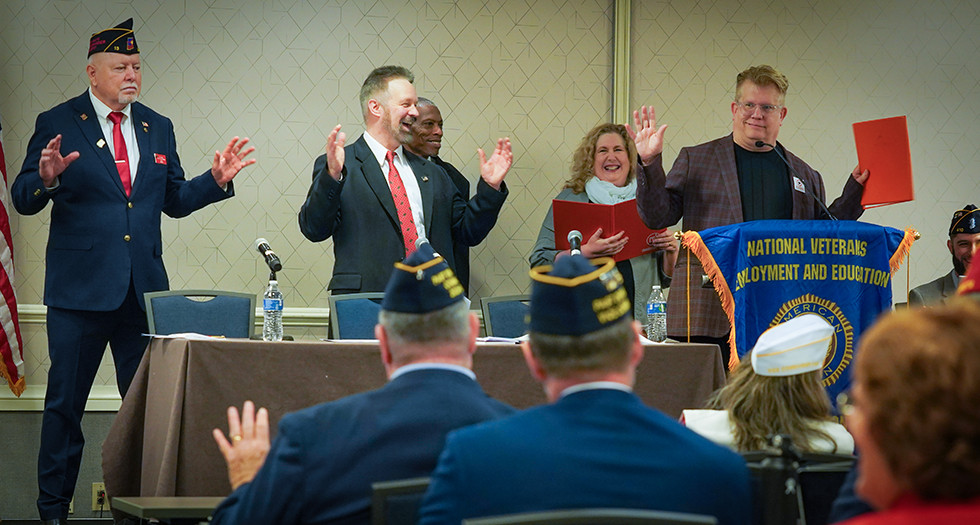
Cleveland Play House shared details about ‘Stories That Matter’ with Veterans Employment & Education Commission.
A drive to improve civics education has the country’s oldest regional theater reaching out to veterans.
Cleveland Play House is unveiling a new program, “Stories That Matter: Patriotism in Performance,” which will address “the critical need of the well-documented decline in U.S. history and civics knowledge amongst our students.”
“Poor civics education is strongly correlated with reduced likelihood to vote. It decreases engagement in political processes. And it diminishes participation in community life,” Pamela DiPasquale, director of education at Cleveland Play House, told The American Legion’s Veterans Employment & Education Commission at their meeting March 2 at the annual Washington Conference. “So it is important that we participate in building these civic learnings with our students.”
DiPasquale said one of the ways to do that is through historical empathy — understanding how people from the past made the decisions they did.
And that’s where veterans and The American Legion come in.
“What we need to do now is be able to find ways to have veterans going through this process tell their stories. That’s what we need most from you guys,” said Marine veteran and Cleveland Play House volunteer leader Paul Beers.
Cleveland Play House associate director of national programs Thomas Kazmierczak said the program’s first year goal is to create a new American history curriculum based on veterans’ stories, and commission and produce productions based on their stories.
In the second year, veteran workshops, training and curriculum would be piloted and productions would begin.
“So you are on the ground floor with us,” Kazmierczak said.
Cleveland Play House is working on a website with more information on the project.
Other speakers at Monday’s meeting addressed a number of topics related to government influence on business and education.
Kristopher Rick, defense industrial base work sector lead at ANSER, talked about the need to grow the defense industrial workspace.
“We very much look forward to partnering with the Legion to conform and educate across the country, all states and territories, of the opportunities associated with defense industrial base employment that are funded by, yours and mine, taxpayer dollars that we execute training programs for and can take those veterans, transitioning servicemembers and military spouses into great careers.
“We absolutely need veteran leadership in the defense industrial base workforce. It is a critical national security imperative,” Rick said.
Jessie Jane Duff, deputy assistant secretary for Policy at the Department of Labor, emphasized the importance of employment for transitioning servicemembers.
“The reality is, if your transitioning servicemember or your transitioning veteran doesn’t have a job, everything else falls apart. That’s when we have the drug addiction, that’s when we have the homelessness, that’s when we have the suicides skyrocketing. You know, the divorce rates, families collapsing.
“A job is the critical piece that holds the glue together,” Duff said.
Veteran entrepreneurship is a focus of the Small Business Administration, said Kevin Barber, assistant administrator, Office of Veterans Business Development.
“We view veteran entrepreneurship as more than small business owners, we see them as economic leaders, job creators and community anchors,” Barber said.
Ken Smith, executive director, VA Education Service, gave updates on progress on the Digital GI Bill.
“We’re very much focused on improving veteran outcomes, making sure that veterans have their benefit, they’re not waiting for those benefits,” Smith said.
The executive director of the VA Loan Guarantee Service is focused on educating veterans and others about the program.
“One of the things I want to focus is on is education,” Patrick Zondervan said. “And it’s not just education to veterans, it’s also education to the servicers, the industry holders and the real estate agents. … I want the veteran to know what they’re entitled to.”
Task Force Movement Executive Director Elizabeth Belcaster and Ben Valinsky, national director for programs and education for the International Union of Elevator Constructors Veterans Assistance Program, also spoke to the commission ahead of Tuesday’s Task Force Movement roundtable discussion.
Homelessness panel. A panel led by Swords to Plowshares Deputy Director Mark Walker discussed metrics, housing options and other topics related to homeless veterans.
“These big programs that we’re talking about, the money comes from the federal government, but a lot of the way that it’s implemented is based on what happens in the state and the locality,” said Cindy Borden, director of training and technical assistance, National Coalition of Homeless Veterans. “So if you think of zoning laws, for example, those things happen at the state and local level when you talk about affordable housing being built, and what it looks like, and who can live where. … Those are things you can guys can do at the local level.”
- Washington Conference