

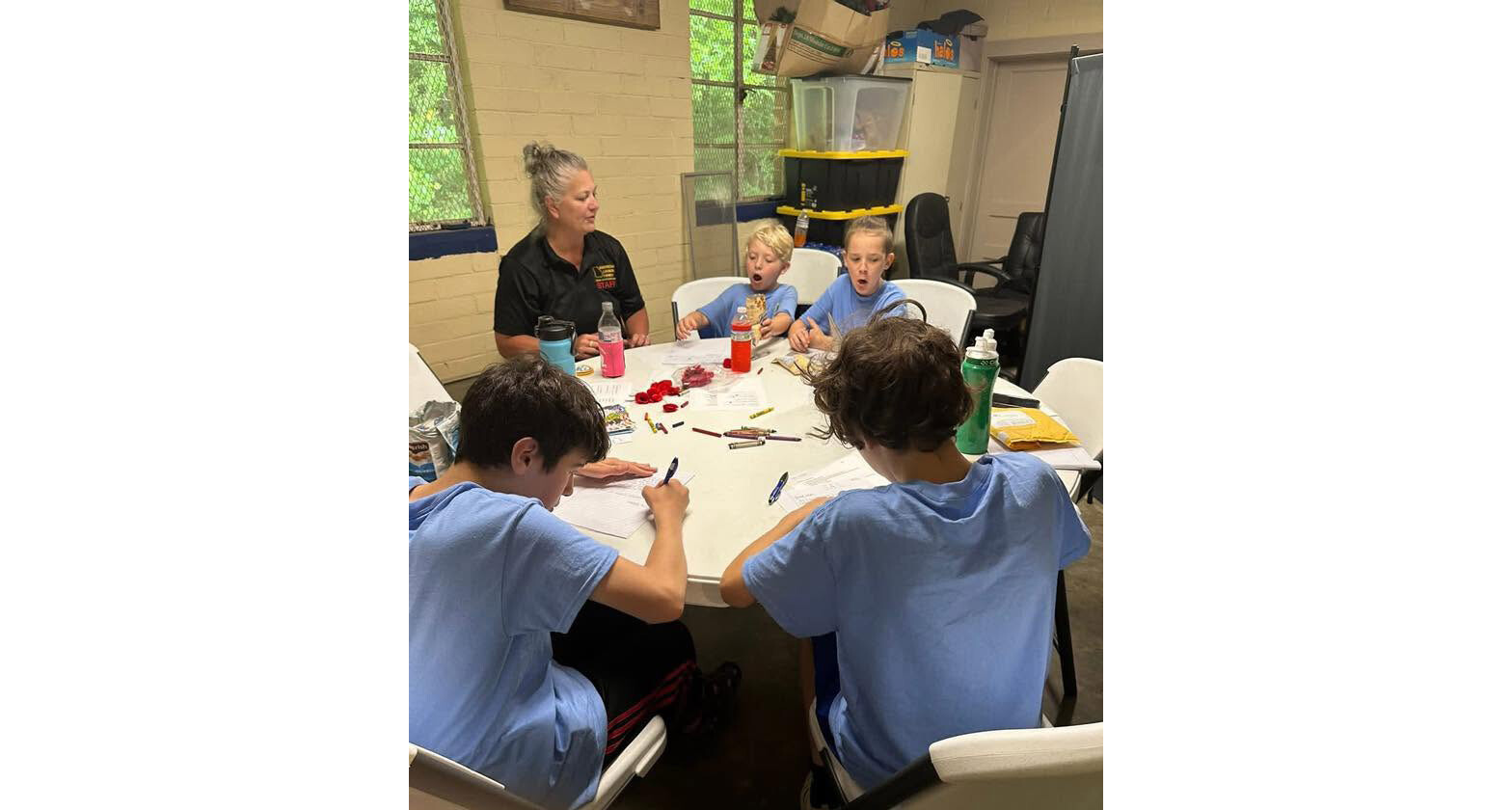
The Legion Family Junior Leadership Camp gives Georgia junior Auxiliary and Sons members an opportunity to be a kid for five days and learn valuable life skills.
American Legion Family members in the Department of Georgia are giving youths ages 8 to 17 an opportunity to put down their electronics this summer to build friendships, develop leadership skills, learn patriotism and have fun in the outdoors.
This is the 14th year for Georgia’s American Legion Family Junior Leadership Camp, where junior Auxiliary and junior Sons of The American Legion members throughout the state attend camp at a Legion post for five nights. They camp in tents separated by gender, eat three meals a day at the post hosting the camp, learn about the Legion Family, hear from community leaders, and participate in crafts and recreational activities. Since its inception, more than 200 youth have participated.
“It’s an actual camp and an opportunity for kids to be kids,” said Brian Shedd, immediate past Detachment of Georgia commander, who has been co-director of the camp for the past seven years alongside SAL member Richard Stanley. “We're trying to teach the children about The American Legion, about ethics, about morals.”
This year the Junior Leadership Camp was held at American Legion Post 189 in Harris County from May 30-June 4 with 22 kids. The kids checked in for camp on Saturday, and classes and activities began Sunday morning with camp counselors who are Legion Family members. The camp is often held at a different post each year to give youths statewide an opportunity to attend and Legion Family members the experience to be counselors.
Upon their arrival, camp attendees give their electronics like cellphones and iPads to the camp counselors, but they are allowed to have them at times throughout the day to use and call home. The reason is to help the kids interact and communicate with each other face-to-face and not with a device.
“A lot of them are hardwired when they first get there, because electronics are their life and they don't want to give up their phones,” Shedd said. “But by day three, you have to remind them to call home because they forgot about those electronics. They really have. It amazes me … it's almost like a decompress and then a reset for the kids, and it is for us too because if they're not out on their phones messing around, neither are the counselors.”
Each camp day starts with a class and then leads into activities such as:
· Swimming
· Arts and crafts
· Card and board games
· Tubing
· Visits to museums and the movies
· Bonfires
· Community service projects
· Fishing
One year, Shedd said a few of the girls attending camp refused to eat the catfish that was caught and cleaned, so camp counselors made chicken nuggets for them. However, when dinner was done, not a single chicken nugget was touched. “They started eating catfish, and then we didn't have any catfish left. But the nuggets were still there. So they learn a lot, and we teach them as much as we can.”
A few of the many classes taught include the history and programs of the American Legion Family, how to fold and display the flag, and how to conduct a flag retirement ceremony. Shedd shared that several camp attendees have gone on to attend Georgia Boys State or Girls State because of hearing about the programs at camp.
“So we're promoting The American Legion in all aspects as a Legion Family,” he said.
Two tests are given during camp that include flag etiquette and how to conduct a retirement ceremony, and then one on a specific aspect of the organization. This year was the SAL’s Five-Star Award Program that recognizes and encourages excellence in:
Patriotism – knowledge on the history of the flag, proper way to display it and show respect.
Citizenship – a working knowledge of the qualities of a good citizen.
Discipline – respect for rules and obedience to them.
Leadership – develops qualities of leadership in athletics, drill formations, and school and church activities.
Legionism – understands the ritualistic work and programs of the SAL.
To ensure each camp attendee understands the roles and responsibilities of post leadership during a flag retirement ceremony, about four or five retirements are conducted. “It gives everyone a chance to do the readings, retire a flag and be the chaplain or the first or second vice,” Shedd said. “Everything like what you would do in The American Legion. We just do as much as we can to help the kids grow.
“I had a little bit of a rough childhood, and I decided I would never let any other kids go through stuff that I went through,” Shedd added. “So I love working with them. Richard and I are known as Uncle Brian and Uncle Richard because of it.”
The teaching of patriotism and citizenship responsibility was visible one year when a veteran wanted to do a flag retirement at Post 82, where Shedd serves as commander and Legion Riders director. Shedd asked the veteran if it would be OK for camp attendees to help. The veteran agreed and “about three sentences into the flag retirement ceremony, one of the kids was like, ‘You're doing that wrong,’” Shedd said. The veteran asked the youth and other campers if they wanted to run the ceremony and they said yes. “They ran a flawless flag retirement ceremony. That's what we're teaching them. It’s very cool. We try our best to teach them the right way to do things.”
The cost per kid to attend Legion Family Junior Leadership Camp is $25. The priority is to keep it cost-effective for families. This includes the food, two camp T-shirts and activities. Posts around the state see the value in the camp and donate to support it as it has an operating budget of about $10,000, Shedd said.
Over the past 14 years, Shedd said the camp has acquired an enclosed trailer to store all supplies, most of which have been donated, like a grill, utensils, camping equipment, bottled water and showers. Shedd would really like to see more departments have their own Junior Leadership Camp and he’s happy to speak to anyone about it. “We really want to build this program,” he said.
To that end, the campers receive a questionnaire upon graduation that asks what they liked most and least about camp. Least is always taking tests in the summer. However, “what they like most is the camaraderie between their friends, getting to see the friends they didn't get to see all year,” said Shedd, who has three grandchildren that attend the Legion camp. “They are able to keep in touch through cellphones and video chats and stuff like that, but physically getting to see somebody that lives six to eight hours away from you once a year is a treat because they made lifetime friends at this camp. And that's what they really enjoy is getting to see their friends year-to-year.”
- Youth