

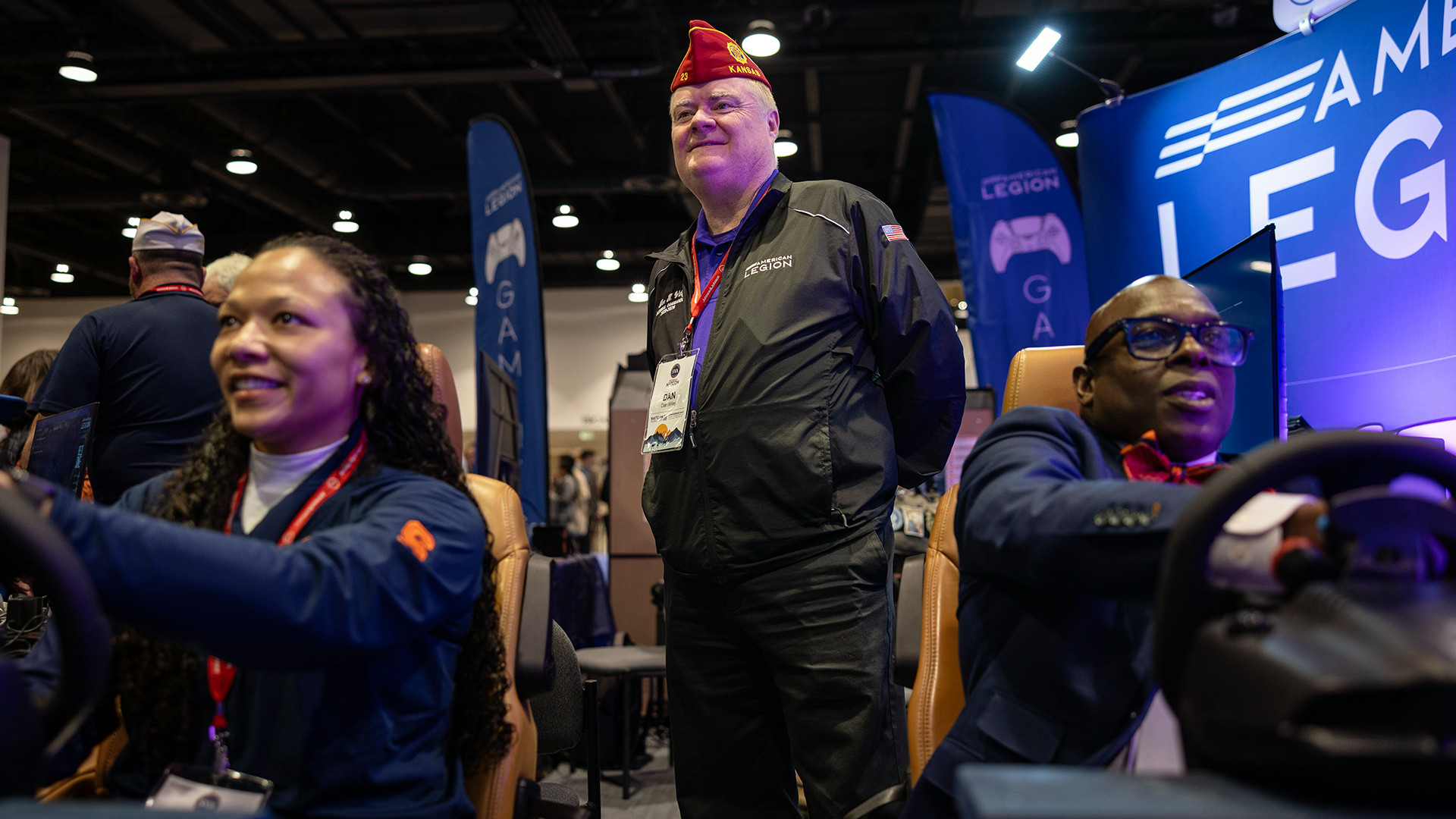
Connections made between growing e-sports program and the Legion’s Be the One mission.
As American Legion Gaming volunteers were setting up PlayStation 5s, Nintendo Switches and racing simulators at the 18th Student Veterans of America National Conference Thursday in Colorado Springs, others setting up their own booths began to take notice.
The screens lit up and flashed to life in The American Legion’s space. Other exhibitors soon suspected this was not going to be an ordinary 8-foot, draped table loaded with pens, mints, stickers, business cards and brochures to stuff into swag bags.
“Even before the hall opened, we talked to several student vets and others among the exhibitors who play video games who said they would be interested in starting American Legion Gaming e-sports chapters at their SVA chapters at their colleges back home,” said Jared Morgan, adjutant of Ronald Reagan Palisades Post 283 in California and American Legion Gaming’s CEO.
That evening, when some 2,000 student veterans poured into the SVA NatCon exhibit hall “campus,” the suspicion was confirmed. Crowds swarmed into the Legion space, which prominently displayed dual messages of Be the One and American Legion Gaming.
“The energy in this room really is unbelievable,” American Legion National Commander Dan K. Wiley said after finishing a racing game against another veteran. “You can feel it. Maybe it’s just being around young people – I can almost remember those days – but there’s a lot of people visiting the booth. This is clearly something, in this gaming, that the younger generation is interested in.”
Among those interested was Navy veteran Christopher Stucke, a Rogue Community College business major, SVA chapter president and member of American Legion Post 28 in Grants Pass, Ore. “I love gaming,” he said, recalling how video games with other veterans helped him get through the isolation of the COVID-19 pandemic.
“It kept me connected with other servicemembers, some people I served with who kept getting orders and moving around the country and around the world … A lot of these games, you are playing on a team. Everything is a team effort, right? It really draws us in that way. It’s also just talking and connecting. You have a headset; you talk to a person on the other side. You talk to them when they are going through something, or they are talking to you when you are going through something. That loneliness – it definitely curbs that in a lot of ways. Just because they’re on the other side of the world, or the other side of the country, they’re right there when you’ve got that headset on. You’re just a game invite away from another veteran.”
The American Legion Gaming station married up well with the Legion’s primary program at the conference, to train veterans through the Be the One mission to detect veteran suicidality and prevent it from happening.
“One of the factors in suicide is loneliness – being on your own, not thinking you have friends, or people that support you,” Wiley said. “This is a community that can get together and support one another, and spend time with one another, which is really effective in regard to our mission with Be the One.”
Friday’s schedule at the SVA conference included an American Legion/Columbia University Be the One veteran suicide-prevention training session.
“There’s a lot of therapeutic value in gaming,” Wiley said. “There’s a whole community of people who get together around certain games. It’s bonding time. It’s a time for them to reconnect, to keep those friendships alive.”
“I’ve seen what this can do for the Legion,” said American Legion Department of Arkansas Vice Commander Allen Edwards. “We’ve had a lot of times when we’ve had veterans in the chat at 11, 12, 1, 2 or 3 o’clock in the morning, and someone is always on. And they just talk. So, we’re being that one. We can be that one.”
One veteran who was on the American Legion Gaming’s Discord network – now nearly 10,000 strong, having grown by about 3,000 over the last six months – was a federal employee struggling to make rent during the government shutdown last fall, Edwards said. The American Legion Gaming community was able to provide support and get him help to cover costs until his paychecks resumed.
“That’s the power of The American Legion,” Edwards said. “That came from out of the Discord. That’s huge. We actually keep track of that. We have a spreadsheet of it. That’s how many times it has happened.” He said games have been paused when players detected risk from other veterans on multiple occasions, sometimes leading to a Veterans Crisis Hotline call.
STORY CONTINUES BELOW
Edwards got involved with the initiative – now with about 12 department gaming committees nationwide and more forming this winter – at the 106th National Convention last August in Tampa, Fla. Now, he is the volunteer director of field operations for American Legion Gaming.
“Within 10 minutes, I was sold,” the Coast Guard veteran and commander of Post 2 in Monticello, Ark., explained. “Even our older guys, coming in there and jumping in a racing chair or playing Mario Kart … seeing that joy on their faces. I knew it could be a tool to combat that isolation that veterans are suffering from – bring them out of that shell a little bit. My biggest drive in life has always been to help my brothers and sisters. Getting to do that, and getting to do gaming, I couldn’t ask for anything more.”
Edwards said that gaming is growing his post’s Sons of The American Legion squadron and re-invigorating its American Legion Auxiliary unit. “My department is very supportive of it,” he added. “My department commander sees the potential this has for driving membership with The American Legion, as well as the interactions we are getting with the other generations that are coming. We need these young veterans. Getting this young blood in there, getting these young guys and gals in, I think it’s a game changer.”
Gaming, Morgan added, is changing stereotypes and driving membership. “American Legion Gaming is a way to introduce younger veterans to The American Legion. That’s the bottom line. That’s why we’re here at SVA. This is the demographic that we should be engaging with.
“It’s such a natural pairing. SVA is an organization that really values the student veteran, a real advocate for the student veteran, and so is The American Legion. And so, I think it’s only natural that we have a presence here.”
- Be the One