

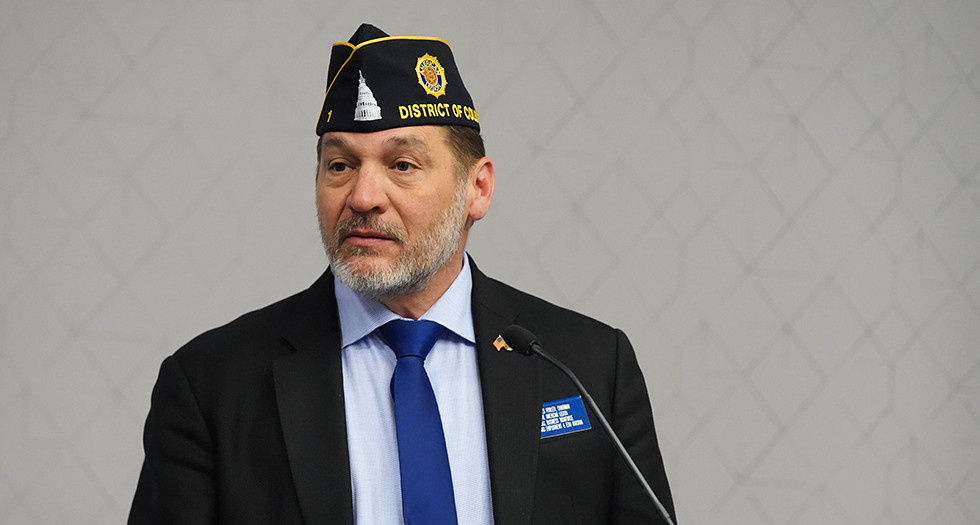
American Legion summit brings together leaders from federal agenices, the private sector and nonprofits to discuss veterans’ opportunities to strengthen the sector.
A collaboration between The American Legion’s National Security Division and Veterans Employment & Education Division during the recent annual Washington Conference brought together leaders from federal agencies, the private sector and nonprofits to discuss veterans’ opportunities to strengthen the national defense industrial base.
The Defense Industrial Base Conference was a day-long event that looked at ways to strengthen the defense industrial base through workforce development and small business. Discussions during the conference included veteran small businesses in the defense industrial base, a small business conversation from a pair of U.S. Small Business Administration (SBA) staff members, the defense supply chain and workforce development through apprenticeships and the talent pipeline into those jobs.
“The American Legion created a national Small Business Task Force to ensure veteran entrepreneurs have a seat at the table and national conversations about important areas like procurement, workforce and supply chains,” said Charles Fowler, chairman of The American Legion Small Business Task Force. “Today we’re bringing together leaders from government, industry and workforce development to talk about how to strengthen the defense industrial while expanding opportunities for veteran-owned businesses.”
SME’s Dan Sloan, director of Industry & Workforce Partnerships for SME, provided a look at the defense industrial base from a business and economic perspective. SME is a Michigan-based nonprofit that represents the entire North American manufacturing industry, including manufacturers, academia, professionals, students and the communities in which they operate.
Sloan said that various entities have done a strong job in industrial base workforce development, with companies that supply parts and materials for the Department of Defense employing more than 1 million people. But “in that manufacturing and industrial base, there is currently a shortage of 800,000 manufacturing job roles,” he said. “Now we’re getting into the vulnerability of the defense industrial base. (There are) 250,000 in skilled trades alone. That’s today. And the forecast is if we aren’t able to reverse this trend, we could be looking at over 2 million manufacturing jobs going unfilled in the next five years. That’s vulnerability.”
Kristopher Rick, who spent more than 30 years in the U.S. Army and now serves as Defense Industrial Base Workforce Sector Lead for ANSER, served as the conference’s keynote speaker. ANSER is a consulting firm that provides objective studies and analyses to the national security, homeland security and public policy communities.
Rick used some of his time to talk about the Industrial Base Analysis and Sustainment (IBAS) program, which is managed by the DoD’s Innovation Capability and Modernization office and is aimed to improve the readiness and competitiveness of the U.S. industrial base by establishing high priority domestic capabilities for new supply chains needed for national security and mitigating exposure to global supply chain risks.
“Within the IBAS program we focus on projects that bring together basically four different areas of workforce development as it relates to the defense industrial base,” Rick said. “Submarines and shipbuilding have obviously been the big forefront in the news. The workforce required. That specific area lies within our kinetics sector, which also includes hypersonic missiles, missions (and) one-way attack drones that we have now seen our country use in combat. And the development of other kinetics capabilities and replenishment of those supply chains.
“That is a big sector. It’s growing in investment. We’re mainly focused on manufacturing, but also the critical supply chain associated with it.”
Rick said the second area of focus is critical minerals. “We are making investments – significant investments – to reopen mines in this country that have been closed for decades to drastically increase the processing and refining capabilities in the country,” he said.
The third area of importance is casting and forging, while the fourth is microelectronics. He also spoke about the importance of hiring and retention within the workforce. “We’re getting them hooked, we’re bringing them into these training programs, but unless we can get them hired and, more importantly, retained in the defense industrial base, we’re kind of just throwing money at the problem,” he said. “We’re working very aggressively with workforce systems, the National Association of State Workforce Agencies, National Labor Exchange, industry associations (and) our partners to address hiring pathways, expand them and then really start to work with the employer side of it on, ‘Hey, you’ve got to retain these individuals when they come in’. Compensation packages have to be appropriate based on the skillsets you’re bringing on board, or you’re going to lose that talent immediately to non-bid competitors out there who can pay higher wages and take better care of that workforce.”
During a small business fireside chat, representatives from the SBA discussed the current climate for veteran-owned small businesses, as well as a recent review of a program designed to assist small business owners struggling financially.
“There’s no better time to be a veteran-owned small business in the United States than it is right now, I think, with the support of SBA,” said Kevin Barber, SBA’s Assistant Administrator for the Office of Veterans Business Development. “We’re looking at a whole new paradigm of how we deliver our services to veterans. One thing I see that I’m working on right now is increased government contracting. That’s my charge right now. Right now we’re looking to deploy short-term capital, $3.1 million, into the marketplace.”
Ryan Lambert, associate administrator for the Small Business Administration’s Office of Government Contracting and Business Development, gave an update on SBA’s 8(a) Business Development program, which is a federal contracting and training program for experienced small business owners who are socially and economically disadvantaged.
Lambert said the program is going through “a very thorough review into eligibility for every participant in that program. What we’ve seen and was released two or three weeks ago was that there are firms in there that are no longer for that program but have been in that program. So they were receiving contracts through 8(a) that should not have been in the 8(a) program. So we are taking quick action. We immediately suspended 154 firms out of the D.C. area. As that review continues outside of D.C., we’re seeing more and more.
“One thing about that 154 firms, they represent about $1 billion dollars of sole source (contracts) over the past four years. So that is an incredibly high amount of money. The point of these programs is to give opportunities to (certified veteran-owned small businesses) and others, so we want to make sure that only eligible people can come in.”
During a panel on supply chain resilience, Active Associate Administrator for SBA’s Office of Manufacturing and Trade Lisa Shimkat listed some of the areas where gaps exist in that chain.
“It could be a critical mineral supply chain to food processing and the defense industrial base as well,” she said. “That’s where we’re really focused: How can we plug people in, because we feel there are so many things out there that are the best-kept secret. We have folks sitting around the table saying, ‘I need a manufacturer that does this’. And at that same table … somebody on the other side said, ‘I make that’.
“That’s where we’re really trying to make those connections and figure out how we can plug in manufacturers, how can we plug in small businesses, so that we can tell a better story and create well and really spread out what needs to happen in America.”
Chris Cortez, vice president of Military Affairs for Microsoft, provided an update on the corporation’s Microsoft Software and Systems Academy (MSSA) program during a panel on workforce development, apprenticeships and the talent pipeline. MSSA provides transitioning military servicemembers and veterans, for free, with the skills needed to get into the IT industry as well as to benefit the company and industry nationwide.
Program participants elect to specialize in Cybersecurity Operations, Cloud Application Development or Server and Cloud Administration. Upon completion of MSSA training, participants have a pathway to achieve Microsoft certifications aligned to their learning path, with an opportunity to put them to use with Microsoft or some of their 1,100+ corporate partners.
“You have to apply. You have to interview. You compete,” said Cortez, who spent 33 years in the U.S. Marine Corps. “Twelve years. Almost 4,300 graduates. Twelve hundred companies hiring from the program. A 94-percent graduation rate and 97-percent employment rate. This is a game-changer. Very few people are aware of it, but this is an example of an organization stepping up and giving something meaningful for those that served.”
- Careers