

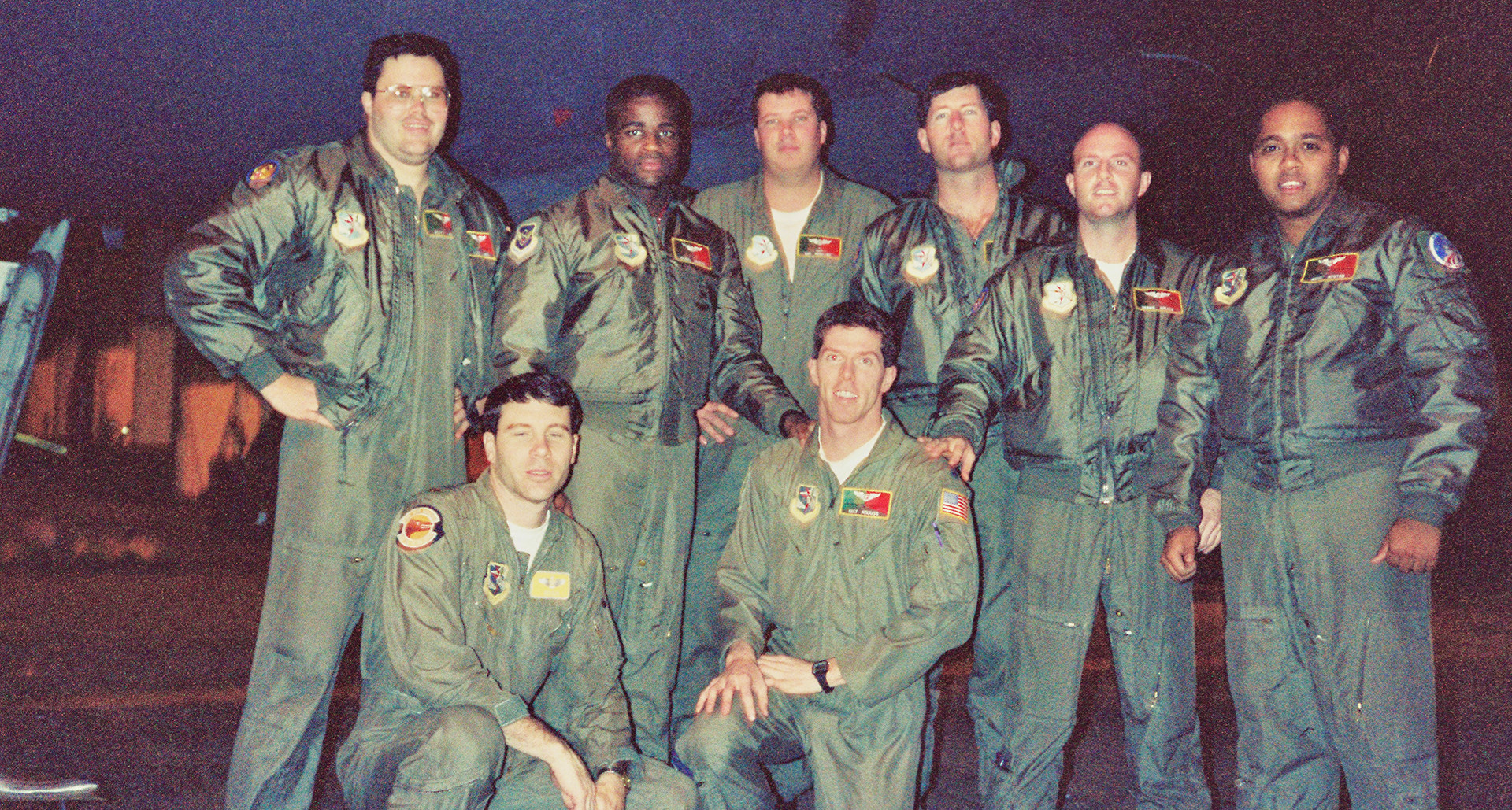
In “DOOM 34,” retired Air Force Col. Trey Morriss gives an insider’s account of the record-setting combat strike.
They called it “Secret Squirrel.”
A mission so highly classified it needed a nickname so aircrews could talk training and logistics without giving away its actual code name: “Senior Surprise.”
More than three decades later, the combat strike that opened Operation Desert Storm stands as a watershed moment in U.S. military and aviation history. On Jan. 16, 1991, seven B-52 Stratofortresses took off from Barksdale Air Force Base in Louisiana, flying 35 hours and 14,000 miles on a nonstop, out-and-back mission to knock out Iraqi power and communication targets. Each was loaded with AGM-86C conventional air launched cruise missiles (CALCM), the first GPS-guided weapon to be used in combat. Operational success and the bombers’ safe return demonstrated America’s ability to launch precision strikes against targets anywhere in the world from bases in the continental United States -- truly global reach.
At the time, however, the only guarantee was that the mission was dangerous -- and of paramount importance.
“You’ve got to get this right,” Lt. Gen. Buck Shuler, commander of the Eighth Air Force, told the crews as they prepared to fly. “This mission is the most significant since Gen. Doolittle’s Raiders took off for Tokyo.”
In his book “DOOM 34: A Firsthand Account of the Top-Secret Mission that Launched Operation Desert Storm,” retired Air Force Col. Trey Morriss, who served as electronic warfare officer on the fourth B-52 (Miami Clipper II, call sign “DOOM 34”), tells for the first time the human story of the mission: tense multiple air refuelings, frustration at mechanical failures and technological glitches, the nerve-wracking turbulence of flying blind through a storm, creeping fatigue as the hours accumulated, the relief and pride felt on touchdown at Barksdale.
Morriss recently spoke with The American Legion about how Senior Surprise laid the foundation for today’s long-range combat strikes, the unique bond shared by bomb crews, and what prompted him to finally write a book about the historic mission.
The Senior Surprise mission was 35 years ago. Does it seem to you like it happened yesterday?
A lot of it does, especially seeing the current missions flying out of Eighth Air Force and how we project power as a country now. I call it our “six degrees of separation” moment; our national defense strategy, as defined by the Trump administration, talks a lot about how we project power through bombers. You can trace its origin back to that mission. So yeah, it does feel like yesterday, especially when I had to do a lot of reflection and begin to remember a lot of the facts. To be honest, that was a tough thing to do.
And I'm still working here at Eighth Air Force, now as a government employee. I'm director of staff for the Mighty 8th Air Force commander. I still hold a top secret security clearance, so that was another challenge when writing. Where do I be careful not to cross over into a classified area that is still classified today?
You and your crew understood you were attempting something never before done. Has your appreciation for your part in it grown?
Absolutely. I mean, it was audacious then. It would be audacious today. But the worst thing about military members, especially when you're in the midst of a history-making event like Senior Surprise, is you often shrug your shoulders and say, “Eh, I was doing my job. I was just doing what I was trained to do.” That's part of why this story took so long to come to some kind of book or recounting of the mission. If you do it by the numbers – 14,000 miles, 35 hours – we knew it would be the longest combat mission in history. But you don't really understand the weight of it until time marches on and you see how that mission underpins the way we fight today. Ten years after that, the B-2 bomber broke our record for the longest combat mission, but we still hold some records. It's the first mission where (we) took off from the 48 states, struck targets in another country and flew home, completing a round-robin mission from the United States. It’s still setting the standard.
Instead of writing a straightforward there-and-back account, you put the reader in the confined crew space of the B-52 as they deal with one obstacle after another: engine failure, critically low fuel, deadly weather, two unfired missiles complicating landing. How did you decide on that approach to telling the story?
People see how big the B-52 is on the outside. It has a 187-foot wingspan. So they are taken aback by how cramped it is on the inside. The only place you can actually stand up straight in the crew area is on the ladder, going downstairs to upstairs. I'm not a big guy. I’m about 5’10”, and any place other than that ladder, you are stooped over the entire time. So it's fascinating when people get in the airplane for the first time, eyes wide open at how small it is.
The (book’s) prologue starts at our 25-year reunion. I chose that to kick it off because up to that point, we – the 57 airmen who flew this mission – had never come together for a reunion of any type. Gen. Robin Rand, a four-star general who was commander over what we call Air Force Global Strike Command, was the one who really encouraged us to understand the significance of what we did – own it, if you will – and begin a historical legacy journey that not only tells the story, but doesn't let it wither away.
After that, it was really almost character development. I wanted it to read more like a novel, like a thriller, while staying in line with the facts of the mission. One of the main characters is the cruise missile. That's in large part what created the secrecy of this entire mission, this new capability the United States held, and how that came about. After I got a little bit of that background (in), it felt natural to take the reader hour by hour and even minute by minute. There's never any lack of content. It seemed like every hour something was happening that was either almost mission failure or life threatening or both. Again, that goes back to the fact that this mission was the first of its kind. While our planners and strategy folks did the best they could to understand every unforeseeable thing that might be out there in front of us, you can't cover it all.
You mention the engine failure on takeoff from my jet, DOOM 34. We had already taxied, and nobody saw anything wrong. But when we put a higher demand on the engine through the takeoff phase, all we can guess is oil seals failed, and all the oil in that engine drained out in a matter of seconds. The reason it's important to quickly shut down that engine is you don't want that thing to start to disintegrate and create a greater catastrophe like maybe a fire in the engine next to it. So here we are, barely off the ground, and we've already burned through our margin. At the same time, the navigation computer decided to reboot on itself, and we don't have full confidence that it’s going to get us all the way to the weapons employment point and back home safely.
The B-52 Stratofortresses used in Senior Surprise were already 30 years old at the time of the mission. Talk about the planes and what it was like flying them.
Our airplane was the oldest in the strike force. There’s been more than 740 B-52s built from the beginning to the current H model still in service today. This particular airplane was the G model, built in 1957, the next-to-last production model.
Even today, the B-52 is mostly analog, and it was then. In 1991, we were not in the digital age like we experience it today, but the precursor to it. As I say in the book, we were on the threshold of GPS. The constellation was in its infancy at the time. There were, like, only three or four GPS satellites in orbit, where we have dozens today. The cultural reliance on GPS was not there. Everything was still very analog.
The B-52’s maintainers had to think a lot like that when they came out of their technical schools. But the flyers, you adopted a get-it-done attitude, especially with the nuclear mission. Your DNA was reprogrammed early in your career when you came to the B-52 community, because the nuclear deterrent mission is zero fail. And I think U.S. citizens want it that way. They want us to be zero fail and to have the attitude that we’ll do anything we can to complete the mission, and that's really how you operated when you flew the B-52. It wasn’t super reliable – a lot of redundant systems, thank goodness, but you quickly learned how to address failures and challenges and understand the second- and third-order effects of that failure.
How did Senior Surprise serve as a prologue to missions in the global war on terrorism?
Anywhere you stage a B-52 or even a B-1 or B-2 bomber, to get to the hotspots in the world – Iran, in this case, or some other country that doesn't love freedom and doesn't understand Western values and wants to take those away from us – it could be eight, nine, 10 hours just to get to that region. This long-range conventional strike is founded with Senior Surprise.
I flew 32 combat missions over Afghanistan and Iraq during the global war on terrorism. What I learned earlier in my career from this mission and the enormously long training missions we flew during and at the end of the Cold War really prepared us as bomber crews for these distances, whether B-52, B-1 or B-2. It prepared you from a culture perspective, and an expectation perspective, that bomber air crews were going to have to fly a long way, and endure cold temperatures, hundreds and hundreds of miles from an emergency airfield or any kind of emergency support you might need. It's just not there.
So there’s that culture it built. You can trace that to 1991. And the way we supported special forces and ground forces in Operation Enduring Freedom and Operation Iraqi Freedom … whether an Army Ranger or a Navy SEAL or a Marine recon element, they got their firepower from bombers flying overhead. That was a whole new way of warfare that goes back to this no-fail DNA. Give me a problem, I'll figure it out.
Why is now the right time to talk about the legacy of Senior Surprise?
There's probably many ways I can answer that question. We've got Operation Midnight Hammer this past June with seven B-2 bombers, striking targets in Iran and crippling their nuclear program. In years previous to that, there have been long-range strikes, bombers used as a deterrent force. And I think it's helpful for the American public to understand it's not just that you get in an airplane and fly somewhere for a long time and turn around and come home. You’re over vast amounts of open ocean, and if something goes wrong, there's no place to go but into the water. The amount of planning and teamwork in these missions, the amount of air refueling … it's not just the bomber. There's this gigantic team in the background. It's not as easy as it looks.
Why now? At the time of Secret Surprise, there was almost zero division in the United States. Until there's a cure for human nature, there never will be zero division. But it was a time when, as military aviators in the B-52 community, we had a mixture of diverse backgrounds and skin color. There were all these dynamics from a human perspective that we never even noticed. We showed up, we did our job, we learned to do our job very well. We learned to integrate as a crew, and sometimes we flew two years straight with the same crew. They call it hard crews. You lived together and flew together and took vacations at the same time – not always together, but at the same time.
Our lives revolved around flying the B-52, an incredibly complex and ergonomically challenging airplane, and we functioned as a cohesive crew. We never gave a single thought to diversity, where you came from, or any of the other topics that seem to dominate today's conversations. And there’s another reason why I wrote the book: to show that people that can come together – normal, average people – to do the impossible. And they can do it well.
How did you reconstruct those 35 hours with so much detail? How much did you have to rely on others' memories?
I’d say I got a good 95% on my own, with a lot of reflection. I did have a writing partner with Bonnie Peluso. If there was a portion of the book she felt needed more depth or less depth or didn't make sense to her … she has no military experience, and so she had a very unique outsider view of the content. I’d go off and write a chapter on my own, and then I'd throw it over to Bonnie, and she would kind of do what an editor would do. Then we would meet and walk through it line by line, and she would interview me along the way and really pull out some of these memories. to enrich the passage or sometimes just a simple statement.
After the manuscript was complete, I sent it to all the crew members on DOOM 34: Bernie Morgan and Steve Bass, the two pilots, and Scott Ladner and Andre Mouton, navigators, and Guy Modgling, the gunner. They read it and provided critical feedback. That's where the other 5% came in – to get the conversations correct, especially when it had to do with a specific procedure that was checklist-driven.
I'm an aviator that flew the B-52 for 31 years. As an instructor, I spent almost 5,000 hours in the airplane. So a lot of that nomenclature was stuck in my brain. And I was fortunate to have the crew of DOOM 34 so willing to take the manuscript and really chip it apart. It helped the book to be a very accurate and rich accounting of the mission.
Describe the bond you share with other Senior Surprise veterans.
It's actually grown over time. Even though we knew in 1991 this was history making, and we knew it was bold, and we knew it was hard, and we knew we were maybe lucky some of us got home, we really didn’t talk about it much. Time went on, and people went on to their careers, and we really never came together until that 25th reunion. That's when the brotherhood and the connections started growing. You live quite a bit of life and look back and realize, “That was a big deal.” So every year we do a reunion, and every year on the five we do a larger one. This year, we're having our 35th reunion at the National Museum of the Air Force at Wright-Patterson in Dayton, Ohio.
Another reason I wrote “DOOM 34” is because it seemed like every time we got together, somebody would say, “We ought to write a book.” About three years ago, I was at the 100th birthday party of John Luckadoo. He was a B-17 pilot with the 100th Bomb Group, which was the subject of the miniseries “Masters of the Air” on Apple TV. While I was at the party, somebody recognized me: “Didn’t you do the Secret Squirrel mission?” Chloe Melas, an entertainment reporter for NBC at the national network level, heard us talking about it. It was through meeting her, and her encouragement to get it written, that the book came about.
Is there any conversation about a movie?
Chloe and I have pitched this story to producers. So yes, there's some talk about it.
- Honor & Remembrance