

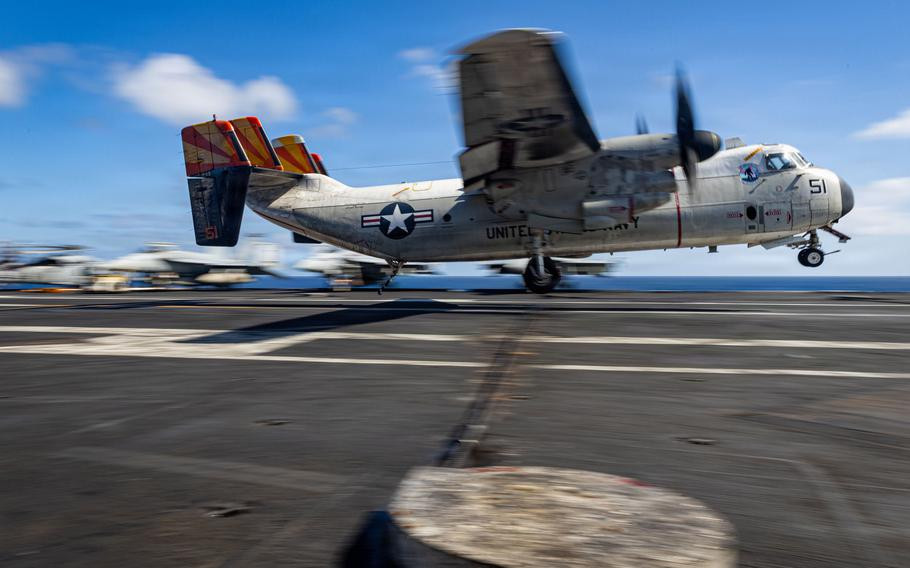
An armada of American warships, stealth fighters and air defense systems is taking up positions in the Middle East, marking one of the biggest U.S. military buildups in the region in years as tensions over Iran ratchet up.
An armada of American warships, stealth fighters and air defense systems is taking up positions in the Middle East, marking one of the biggest U.S. military buildups in the region in years as tensions over Iran ratchet up.
The aircraft carrier USS Gerald R. Ford is on its way to join counterpart USS Abraham Lincoln amid high-stakes talks between the Unites States and Iran over Tehran’s nuclear program.
President Donald Trump has not signaled whether a strike on Iran is imminent should talks break down. But White House spokeswoman Karoline Leavitt said Wednesday that there are “many reasons and arguments that one could make.”
The surge in combat power involves numerous bases stretching from the United States to American military hubs in Europe and the Middle East. That would give Trump a wide range of options if he orders action against Iran.
Open-source flight tracking data has shown significant military activities at locations such as at RAF Mildenhall and RAF Lakenheath, installations in England that are home to U.S. Air Force tankers and fighter planes.
Another air base in the United Kingdom, RAF Fairford, was mentioned by Trump in a social media post Wednesday along with Diego Garcia, a strategic island base in the Indian Ocean.
“Should Iran decide not to make a Deal, it may be necessary for the United States to use Diego Garcia and the airfield located in Fairford in order to eradicate a potential attack by a highly unstable and dangerous Regime,” Trump said.
In recent days, flight tracking data has shown jets including the F-35 Lightning II, F-22 Raptors and F-16 Fighting Falcons traveling from U.S. to American military bases in Europe and on the Middle East. Refueling planes, such as those based out of the United Kingdom, would be able assist those fighters in the event of a sustained attack on Iranian military sites.
In recent weeks, flight tracking data also has shown scores of U.S. cargo planes flowing to Saudi Arabia, Jordan and Bahrain. Meanwhile, U.S. fighters also have taken up positions at Jordan’s Muwaffaq Salti Air Base, open-source data shows.
Trump has been receiving briefings on military options, which include targeting top Iranian officials with the aim over overthrowing the government as well as attacking nuclear and other military facilities, The Wall Street Journal reported Wednesday.
In June, Trump ordered strikes on three Iranian nuclear sites. U.S. B-2 Spirit stealth bombers flew long-range missions from the United States to carry out the strikes. American fighter planes also supported the operation, which destroyed key aspects of Iran’s nuclear program.
The attack led to retaliatory strikes on Al Udeid Air Base, the U.S. military installation in Qatar that serves as a command hub for all Middle East operations.
While U.S. commanders had ordered an evacuation of the base in anticipation of a counterattack, 44 air defense soldiers remained behind to preventing the base’s destruction.
So far, no evacuations of U.S. military sites have been ordered in the region. However, the U.S. has added air defense capabilities in the Middle East in recent weeks, indicating that it’s prepared to respond should Iran target American bases in places such as Bahrain and Qatar.
Patriot missile defense batteries and Terminal High Altitude Area Defense, or THAAD, systems are currently in position, The New York Times reported Wednesday. Necessary assets are in place to defend against any Iranian retaliation, at least for the short term, the newspaper reported, citing an unidentified military official.
- Security