

A Navy veteran explains what’s missing in the transition from military to civilian life.
A young person puts on a uniform, takes an oath and steps into a world that will dictate most everything in the years ahead. Housing. Clothes. Schedule. Values. Then, when it ends, the uniform comes off, the DD-214 is stamped, and the world feels unfamiliar, disorganized and deeply isolating.
The practice of veteran transition is largely failing because we misunderstand what veterans are transitioning from and underestimate how deeply military service transforms an individual. More than transition assistance, veterans need a total reintegration system that recognizes them not as former employees but as citizens returning from a foreign society, speaking a different language, having adopted a different value system and way of life.
The story of the servicemember Consider the new enlistee. Nine out of 10 are in the 18-to-22 age range. For most, military service is the first time leaving their childhood homes. It may be their first real job, their first time living within a set of professional rules and guidelines outside the classroom. Truly, these are the first steps into adulthood. For that enlistee, the next few years will be the most formative of their lives.
Every military branch – though different in culture and mission – approaches with almost-scientific precision the process of transforming barely grown high school graduates into disciplined, cohesive members of high-functioning teams. The adolescent soup of prom nights, professors and parental curfews is abruptly wiped away, breaking a childhood’s worth of social programming to systematically reassemble an identity, one that values cohesion over individuality, purpose over preference. These new recruits still have a long way to go. Seaman or private, second lieutenant or ensign, military culture demands further breaking into adulthood “our way.”
Within those first two years, the 18-year-olds who left home may see themselves molded – and, in the most neutral sense of the term, indoctrinated – into an entire way of life that demands every ounce of their being and has the potential to demand their very lives.
In a parallel story, different 18-year-olds find jobs or continue their educations in order to advance career prospects. They may have a higher calling or purpose, or they may explore a gamut of options. They learn to pay bills, navigate the world of private insurance and consider how they might value their own time and labor. Am I worth $15 an hour at a register, or should I try for sales?
The 18-year-olds striking out into civilian life are, for the most part, independent. They choose where they live and work, what they say and wear. The art of finding civilian purpose is self-driven. They settle into a way of life in general society and have varying degrees of success; it is a natural progression.
To a servicemember, the DD-214 isn’t just paperwork. It is a passport into a world that once felt foreign and still might. Civilian freedom, whether we admit it or not, is fundamentally at odds with the culture we lived and breathed while serving in uniform. Every branch sculpts its recruits to fit the needs of the mission, not the demands of life after service. And it must. There is no room in warfighting for ambiguity or personal preference. But that necessary indifference to post-military life means that when the uniform comes off, we carry tools no longer suited to the environment we’ve re-entered, with a mindset conditioned for a world that no longer exists for us.
My indoctrination into this way of life began with a bet I made as a scrawny 12-year-old. I remember sitting at a lunch table with my best friend at the time, a goofy kid named Wencelius, as we watched some other middle schoolers parading around in the ACUs of Sanford Middle’s Air Force Junior Reserve Officer Training Corps.
“If you join this for a semester, I’ll do it.”
I’ve never been one to turn down a bet. A few months later, we were standing at attention outside a dinky portable classroom. That was my first foray into military life. I remember being terrified of these bigger, badder eighth-graders, with their tucked shirts and ironed blouses. I remember stressing out over my inability to perform a right face for months, and the deluge of ranks, symbols and standards.
This tiny classroom-sized unit motivated me to join Navy JROTC in high school; I made that unit my bubble. We went on yearly trips to Parris Island. We learned about naval history, leadership and accountability. By my senior year, I was thoroughly disinterested in the discussion of which college to attend, which path to take. I was going to make the military my career, and by extension, my life.
The transitioning veteran The most at-risk veterans for suicidal ideation, substance-abuse disorders and other mental health-related crises are those recently separated (within one year), ages 18 to 34, and particularly those who encounter economic hardship.
Is this all that surprising? We have taken a collection of children, thrust them into the fast-paced breakdown/buildup regimen of preliminary training, and then into a high-strain world that coexists with, but rarely crosses into, the civilian world. We can put aside the obvious risks associated with military service: being away from home, engaging in armed combat, the everyday perils of handling live ammunition and dangerous machines of war.
Most servicemembers do not see combat or receive debilitating injuries, yet they leave the service to struggle in immense numbers. Why?
If transition is to succeed, we must abandon the idea that the goal is to make servicemembers into successful civilians. Veterans are legally civilians, but the level of social programming undertaken in those formative years cannot be undone in a matter of months. We must approach veterans much as we would immigrants from another place – fresh faces seeking belonging, who speak in mystifying acronyms, reference odd customs and permanently carry stories shaped by a strange logic few others can understand.
What makes military life another world? For many, the military meritocracy is the worst meritocracy ever created – except for all the others. It is one where the career progression is clear, where there are inputs and outputs that are clearly measurable, and qualitative and quantitative assessments guide every process. It therefore may be an alien idea that simply smooth-talking and pitching an idea in an interview may be enough to make you someone else’s boss. Imagine if an E-3 could merely interview and jump the line to become a first sergeant or second lieutenant. Yet that reality plays out every day in the real world. True meritocracies have a layer of controlled ascent that may be frustrating, but scarier still are systems where you simply do not know what random quality will land you that job.
Veterans know the truth: beneath the rank and ribbons, we’re all just people. For every proverbial Captain America, there’s a Pvt. Pyle – or several. And not everyone who wears the uniform is noble, disciplined or honorable. But for the majority, there’s a shared understanding born of hardship, a tacit trust that even if we differ wildly in personality or politics, we’ve endured something together. And for all its dysfunction, military service rests on a baseline belief that your teammates want to do the right thing. Much as civilians have freedom of choice in their professions and styles, there is whiplash associated with veterans encountering people who actively encourage inherently selfish activities. After living in a world that at least attempts to present a higher purpose, for some organizations and civilian professionals there is no moral purpose at all – only profit, advancement and comfort.
Lastly, many of the military’s stress factors are largely mitigated by other assurances. Rank structures are clear. Health care is socialized, accessible and requires little else other than to show up. No matter how dire your straits, there is always a ship or barracks room and a questionable dining facility to fall back on. The military provides a safety net for everyday life to reduce anxiety over basic needs so attention may be directed at operational objectives.
In 2015, I reported to The Citadel, the Military College of South Carolina, on a Navy ROTC scholarship. It was my first look outside the rosy, insulated world of high school JROTC and into the harsher reality of military culture. Four years there taught me to lighten up but left me no less committed to a military career.
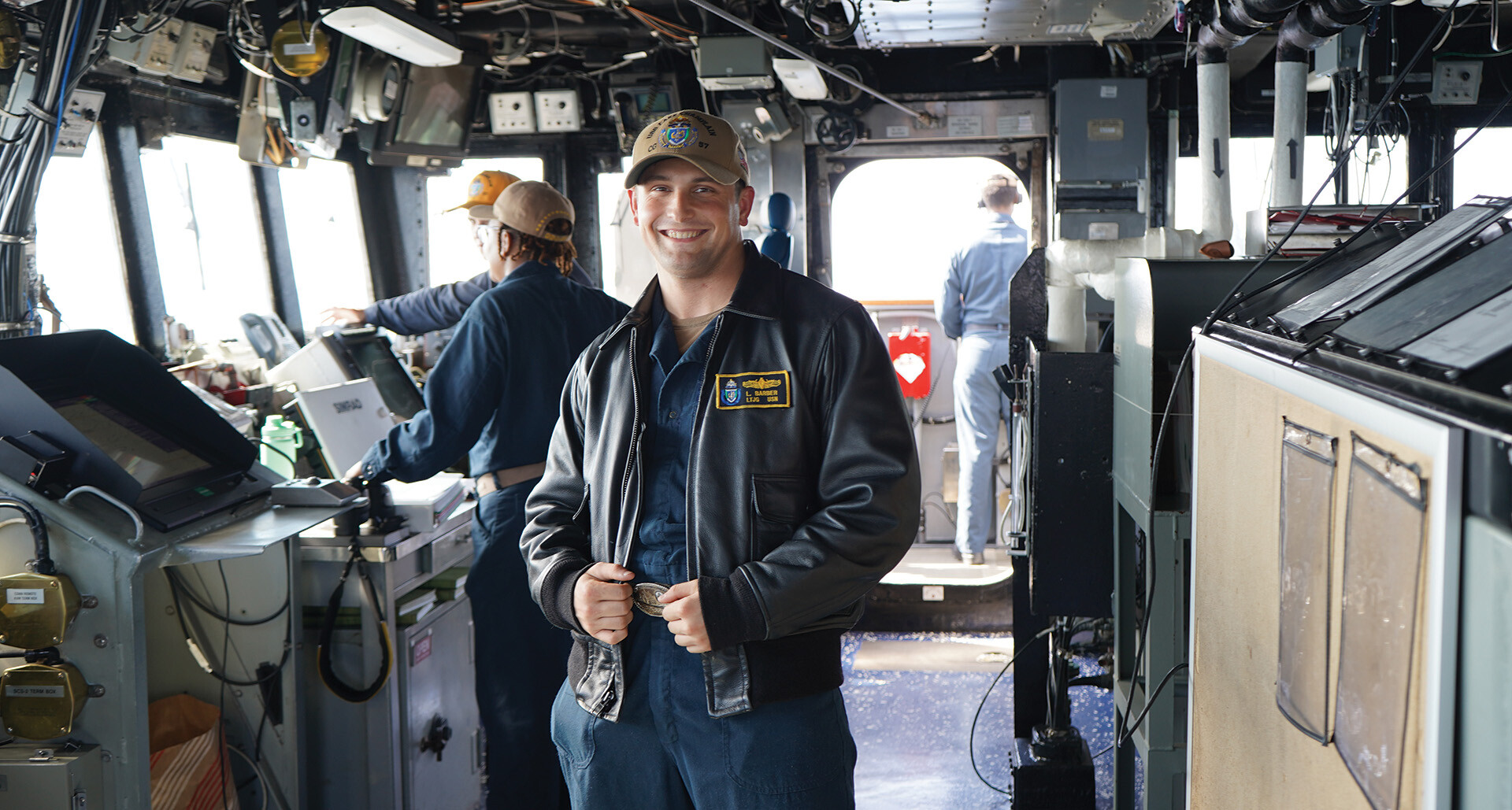
I was commissioned as a surface warfare officer aboard USS Lake Champlain in 2019. The fleet was, in some ways, more relaxed than The Citadel – until COVID upended everything, isolating crews for years at a time and blurring the line between life and service. By 2022, I had accepted a new opportunity at Fort Meade, Md., expecting to dive into a fresh Navy career field.
Reality, though, has a way of punching us in the face. An unexpected administrative snag ended my Navy path before it fully opened up. The offer was essentially “back to the ships” or whatever else I thought I wanted to do. I had the novel idea of joining the Army, following my Citadel roots. Within months, I was navigating the unplanned reality of leaving the service entirely. To make it work, I had to transition to the Inactive Ready Reserve and begin afresh with an Army recruiter.
In the months leading up to separation, I invested a lot of time, energy and money into physical training, language learning and even certifications like emergency medical technician. I left with 0% disability and breezed through the Transition Assistance Program. What did it matter? I would be back in the service soon.
Until it was all upended, once again.
Toward a culture of reintegration So where does this leave us? We at least can recognize that the gulf between active duty and civilian life is more immense than even veterans may fully comprehend. It is a movement from a stressful, dangerous bubble to a wider, more chaotic civilian world that demands personal choices.
To succeed at this, we must meet veterans in transition where they are, through other veterans: leaders who can speak their language, who have been on the other side of the transition process, and who can translate the idiosyncrasies between military and civilian life.
We need to stop thinking of veteran transition as résumé-writing and benefit-claiming. What we need is a reintegration corps – a veteran-led ecosystem that supports identity reconstruction, community re-entry and purpose-finding.
For some veterans, that search leads naturally to careers that mirror the structure and service-oriented ethos of military life. Law enforcement, fire departments and other public-safety roles offer familiar hierarchies, uniforms and clear missions. But we cannot assume that every veteran wants to, or should, pursue a civilian life that mimics military structure. Purpose after service doesn’t have to mean staying in the chain of command. It can mean starting a business, teaching, building communities or creating art. The key is to give veterans the tools to build meaning on their own terms in a way not explorable while on active duty.
Imagine if, upon separation, every veteran is assigned a peer-transition officer – another veteran trained to guide them through a structured year-long reentry program. One that includes local mentorship, civilian cultural orientation, trauma-informed care access and guided purpose exploration. Not a briefing. Not three check-in phone calls. A year-long bridge. Such groups do exist, of course, as non-government and veterans service organizations. But why do so many veterans continue to fall through the cracks anyway?
It is not patronizing to assume a veteran may not know things about civilian life that their civilian peers take for granted. This goes beyond résumés and interview prep; those skills can be taught. What is not taught are distinctions between civilian and military culture.
• In a world without visible ranks and regalia, how do civilians signify their status in the professional hierarchy?
• What does self-advocacy look like in a self-driven professional marketplace?
• In the absence of a chain of command, how does one navigate professional ambiguity?
• How do you interpret performance feedback that’s vague or delivered indirectly?
• What does loyalty mean in a world where people change jobs every 18 months?
• How do you know which rules are flexible and which are career-ending?
• What does “professionalism” mean when it’s not enforced by grooming standards or uniform regulations?
• How do you find purpose in an environment that does not seem to have a higher calling?
No matter how many battles a veteran has fought or leagues they have sailed, there is no avoiding the anxiety that comes with being thrust into the civilian world. Trivializing the anxiety of the unknown, even the very basics of it, is part of why we are failing veterans in transition. Programs cannot just be check-ins that assume a veteran has everything well in hand. We must go by the numbers, for even basic items of life, throughout that critical first year to ensure a veteran can settle into a new reality with as little extant stress as possible. It is not coddling. It is reintegrating.
In late 2023, I reported to a military entrance processing station. As it happened, I was disqualified by the Army based on aspects of my medical record from the Navy – which never even put me on limited duty, affected my performance or gave me the chance at a second professional opinion. The Army merely rejected it, along with the waivers I sent, and third-party evaluations that rated me “good to go.”
I was out, and that was it.
I found myself frantic and aimless, yet unwilling to ask for help from anyone. To me, this was a hell of my own making, and I had to figure it out.
I moved everything I owned into storage and lived in my car for six months, parking by the train tracks where no one seemed to check for “extended stays.”
I found myself making coffee at a local shop for a pittance; the only purpose I found in life was spending time at the volunteer firehouse, running 911 calls. Only the Odenton, Md., Volunteer Fire Company kept me afloat psychologically. I told no one of my homelessness. After being a naval officer for almost five years, it seemed like an embarrassment. I later found other employment with private ambulance companies, working events and running non-emergency transport, yet I still felt dumbfounded by the idea of doing something purely for money. For six months, I was the veteran in transition who didn’t really know what to do, or how to do it, in this new world.
Bringing them all the way home The problem of veteran transition is not solved by checklists. The practice is usually oriented to moving from point A (servicemember) to point B (integrated civilian who happens to be a veteran). It focuses on the end goal of gainful employment, adequate medical treatment post-service, and having a sound mind and purpose. Our current paradigm is like giving someone a license to practice medicine because they shadowed a few doctors. Experience doesn’t equal readiness.
The bridge to civilian life is not built simply on money and medicine; it is built on rebuilding one’s entire sense of community, purpose and way of living. When transition programs take this stark reality into account, they will prioritize connection over compliance, identity over efficiency, and purpose over paperwork – ensuring that those who served are not just discharged but truly welcomed home.
In early 2024, a friend and fellow veteran in Washington, D.C., suggested I apply to congressional offices. Why not? Anything would be better than my life at the time. Yet I still didn’t understand fully that the civilian world did not rely on résumés, eval bullets and quantifiable qualifications; it was a network of who you knew and “Did you intern before?” It was about being in the right place at the right time. After months of frustration, my friend encouraged me to apply for the HillVets Foundation Congressional Fellowship. I was accepted and found myself living in the fellowship’s housing with seven other veterans, working in congressional offices.
The fellowship was unpaid, but merely having a home and a definable purpose was a breath of life. I continued public service via the volunteer fire department and did paid-event medic gigs. I had few free weekends (and many sleepless nights before going into the office again), before I found an organization that understood that what I was going through was not merely a matter of finding a job and becoming a civilian. I am continuing my trajectory of public service working for The American Legion – and as of this writing, as a drilling Navy reservist.
From the age of 13, I expected this life to be permanent and all-encompassing; the military certainly makes it seem like that will always be the case – until it isn’t. And then what? We all think we’re ready when we get out, but even if we leave the service disillusioned, we are leaving a life that rewired us and then sent us on our way with some classes and wishes of “good luck.” What they don’t teach us is how to build an identity that isn’t rooted in rank, billet or branch in a world that doesn’t run on orders, checklists and command structures.
The military prepares us for missions, deployments and high-stakes environments – not for the quiet, unstructured pace that follows. That’s where so many veterans stumble, I believe – not because we lack discipline or drive, but because no one told us that leaving the service means learning how to be a civilian again, from scratch.
Logan Barber is a legislative associate for American Legion National Headquarters in Washington, D.C.
- Veteran Support