
DSO Symposium attempt on recent Ford v. Veterans Guardian VA Claim Consulting LLC, which rules that businesses charging veterans illegal fees for benefits claims assistance now liable for financial damages.
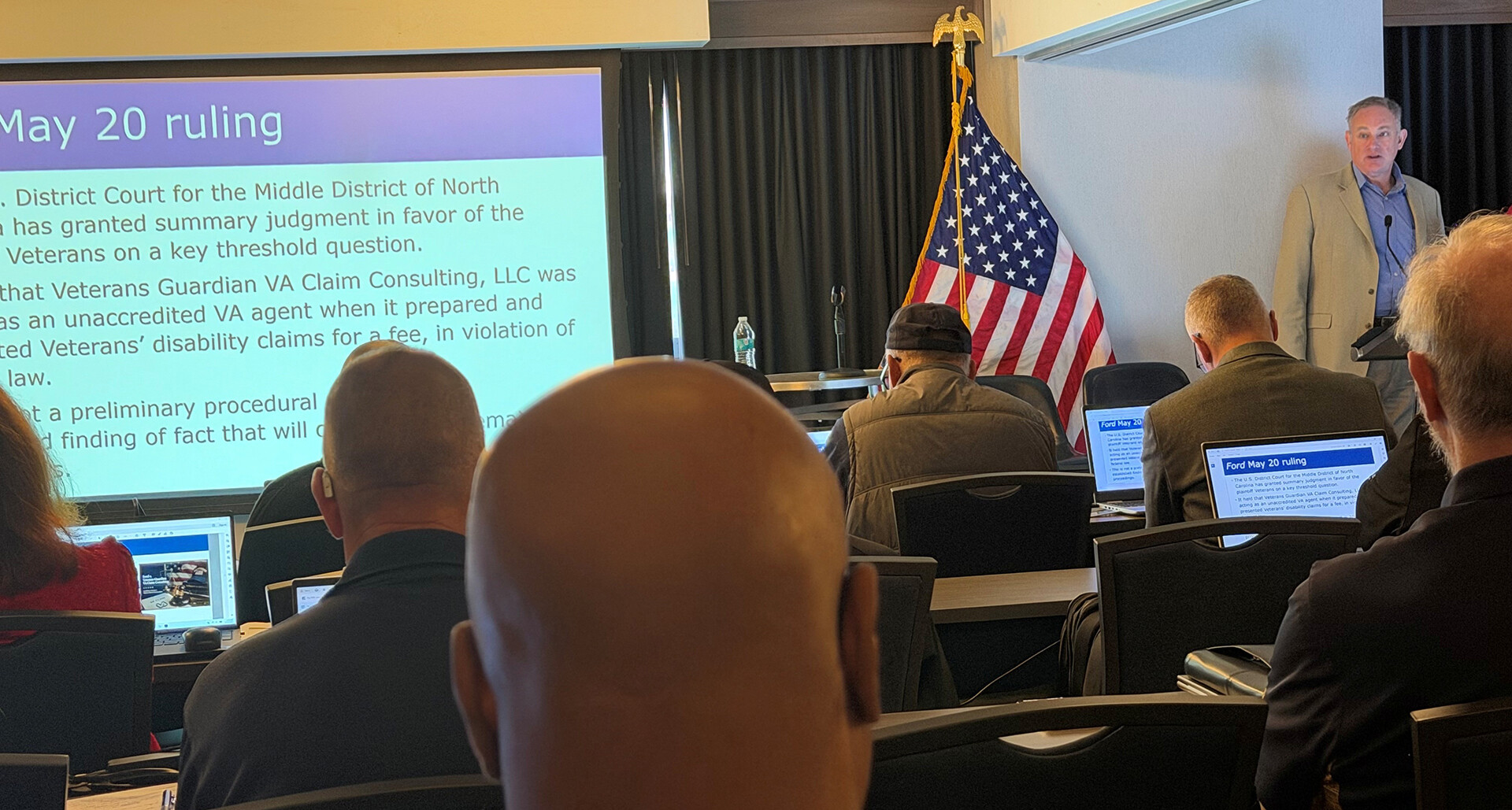
A discussion on claim sharks – specifically, on a lawsuit filed against one in North Carolina – a was a topic of a briefing provided by Bergmann and Moore attorney James Ridgway on Oct. 29 during The American Legion’s third Department Service Officer Symposium in Washington, D.C.
Ridgway, Bergmann and Moore’s Director of Training and Programs and a former judge on the U.S. Department of Veterans Affairs’ Board of Veterans’ Appeals, shared his information with the 62 American Legion department service officers, county service officers and representatives from state agencies undergoing the annual training.
He focused on the class-action lawsuit Ford v. Veterans Guardian VA Claim Consulting LLC. Plaintiffs Jennifer Ford, Eric Beard and Brian Otters are disabled military veterans who retained the defendant, Veterans Guardian VA Claim Consulting LLC, to assist them in obtaining or increasing their disability compensation.
Federal law restricts those who may assist veterans in preparing, presenting, and prosecuting claims for benefits before the U.S. Veterans Benefits Administration to persons or entities meeting specific qualifications and accreditation requirements. The plaintiffs contend that Guardian violates federal law by offering these services without accreditation and that it charges illegal fees in violation of the North Carolina Unfair and Deceptive Trade Practices Act and the North Carolina Debt Collection Act.
“Ford is the most advanced of a lot of these class actions,” Ridgway said. “A lot of different consulting companies have been sued in a lot of different places. A lot of people are watching to see what happens with Ford to get some idea of what might happen in other places.”
During his presentation, Ridgway shared three key rulings in the case that happened earlier this year.
· On May 20, the U.S. District Court for the Middle District of North Carolina granted a summary judgment in favor of the plaintiff, holding that Veterans Guardian was acting as an unaccredited VA agent when it prepared and presented veterans’ disability claims for a fee, violating federal law.
· The following June, the court granted a partial summary judgment in favor of Veterans Guardian, holding that claims arising on or after Oct. 1, 2025, do not constitute an unfair trade practice under the North Carolina Unfair and Deceptive Trade Practices Act or the North Carolina Debt Collection Act; the North Carolina legislature had passed a law that explicitly defined unaccredited representation as not an unfair practice.
· And in August of this year, the court granted a summary judgment in favor of Ford on the ultimate issue of liability, holding that Veterans Guardian’s unlawful behavior renders its liable. The court rejected the defense that veterans were not harmed because they willingly paid the company. The ruling means the issue now is what damages Veterans Guardians owes the plaintiffs.
The August ruling “was the ultimate rule that, ‘Yes, you are liable. You have done something that causes you to owe the plaintiffs money,’” Ridgway said. “Now we are onto the issue of damages and what Veterans Guardians owes to the plaintiffs. Who was affected? How much were they affected? Was anything that anybody paid for separate and distinct from the unlawful behavior that they can’t be charged for?”
Ridgway said that while Ford v. Veterans Guardian VA Claim Consulting LLC was filed in North Carolina and involves a North Carolina company, “It does not matter where they veteran lives. If the veteran is in Wisconsin or Iowa or Virginia or California … you can be anywhere in the country. And when they ultimately resolve this, and they reach out to affected people and say, ‘You’re a member of this class. You’re potentially owed this money,’ you can have veterans coming in to wherever you live with a letter and say, ‘What do I do with it? Should I say yes?’”
A few symposium attendees said they’ve already had representatives from claim shark companies come into their states to lobby for changes in the state laws regarding working without accreditation and charging illegal fees. American Legion Department of Utah National Executive Committeeman Terry Schow was one of those.
“These folks came to Utah, and we neutralized them,” said Schow, who spent nearly 12 years as executive director of the Utah Department of Veterans Affairs before retiring in 2013. “They kept coming to me and asked me if I’d support them. I said not only no, but hell no. It worthwhile for you guys to get a hold of your legislative folks in your state and get to know who the members of your house and senate veterans affairs committee are, or whoever that counterpart is, so they’re familiar that the Legion does this for free, and that we do not support these bottom feeders.”
- Veterans Benefits