
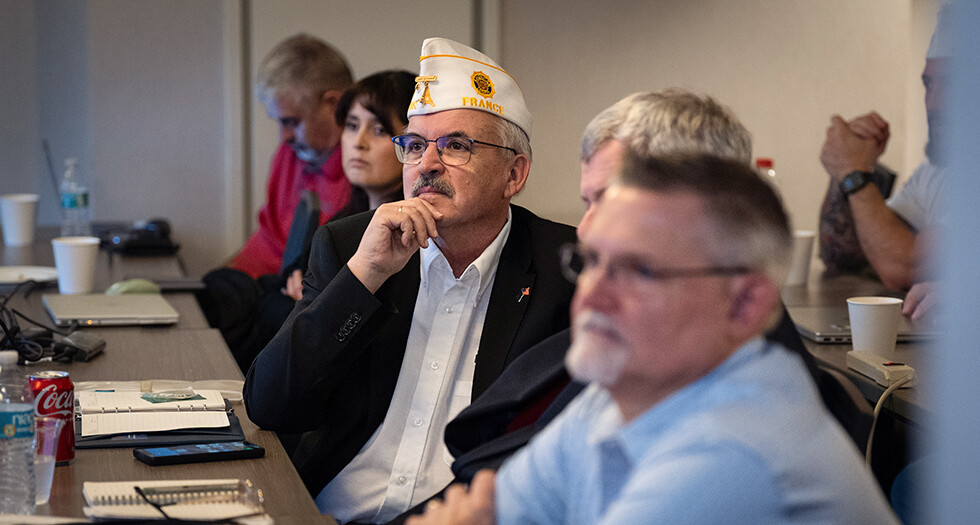
Sixty-two veteran service officers attend The American Legion’s third DSO Symposium.
In 2024, The American Legion teamed with Bergmann & Moore – one of the largest law firms in the country with a sole focus on veterans’ disability benefit claim appeals – for the partnership’s first Department Service Officer Symposium. American Legion-accredited veteran service officers (VSOs) from across the nation, and world, spent a week getting extensive training from Bergmann & Moore staff, which has provided American Legion service officer training and legal consultation since 2017.
Department of Indiana Legion service officer Bryce Hullett attended the first symposium and then returned in 2025 and again this year. He said in the ever-changing world of navigating the U.S. Department of Veterans Affairs benefits system, coming back year after year is necessary.
“I’ll never be at the top of my game because we’re always learning,” said Hullett, the Department of Indiana’s Rehabilitation director and a member of Kenneth N. Dowden Wayne Post 64 in Indianapolis. “Every year we learn something new. We get to meet new people. More networking. And everything changes every year.
“I may hear from a service officer from another state, ‘This is what we’re doing to make this work.’ It’s a great way that we can learn and I can take back to my staff and coworkers and make it better for them.”
The most recent DSO Symposium took place Oct. 25-30 place at the Washington Hilton in the nation’s capital. A total of 62 VSOs from across the nation and the American Legion Department of France attended this year’s session, the most in its three years.
STORY CONTINUES BELOW
One of those was Steve Ramirez, director of The American Legion Los Angeles County Council’s Service Department and a member of Audie L. Murphy Post 817 in Panorama City. It was his second time attending the symposium, and his reasons were the same as Hullett’s.
“There’s something new all the time,” Ramirez said. “This is an ever-evolving position. The cases are never the same. Even though they seem similar, they are not. You never know what’s going to walk in, what kind of difficulties that will be encountered. It’s incredible. And I think that’s what keeps us going: It keeps changing.”
And then there’s the networking aspect to attending the symposium. “I exchange business cards. I say, ‘If you’ve got somebody out there that needs help, or you want to refer somebody, or likewise,’” Ramirez said. “For example, I had a veteran go through LAX, and he wasn’t staying (in the U.S.). I asked him where he was headed, and he said Germany. So I called (American Legion Department of France Service Officer Frank Phillips, who has attended all three symposiums) and said, ‘I need your services.’ And yeah, he picked up on it.”
The networking aspect immediately jumped out to first-time attendee Angela Hall, the service officer at American Legion Post 320 in Spotsylvania, Va.
“You get to network and collaborate with that range of experience and education, and with people a little newer, a little older,” Hall said. “To hear from individuals overseas, from individuals where we all kind of deal with the same troubles and trying to get things accomplished within the compensation and benefits system, or within the health system, it’s just good information.”
Hall said she wanted to attend the symposium “to be a better service officer. This gives me more tools in the tool belt, if that makes sense. It’s to provide better service to our veterans and better service to our department.
“We do an important job. What we do changes people’s lives,” she said. “The training that we receive from the symposium helps us to do just that. It helps us to take care of veterans.
“I’ve been through the (claims) process. It’s daunting. It gets a little confusing and, of course, frustrating. But when you go to trainings like this and can collaborate with other individuals … it helps us build upon each other. To be able to continue to do this allows me to help veterans and empower them. Calm them and cheerlead them through the process.”
Kendal Bishop, a Department of Illinois service officer and member of American Legion Post 974 in Franklin Park, also attended the symposium for the first time. “I’ll be able to use quite a bit of this stuff at the office,” he said. “We have weekly meetings every week (with all of the department’s service officers), and we pass on any knowledge that we get.
“Being able to get people going again and getting people a lot of help that they needed, as well as being able to help them out for the rest of their lives in dealing with their disabilities, that’s why I do this.”
STORY CONTINUES BELOW
The Course Itself. Bergmann and Moore’s lawyers provide the brunt of the training during the week, but attendees also heard from guest speakers that included representatives from U.S. Veterans Benefits Administration and the U.S. Department of Defense-VA Collaboration Office; Eddie Crossman, USAA’s MSO/VSO Liaison and Policy Director; and VA’s Dr. Lisa Arfons and Patricia Hsing. The latter two spoke about both VA’s RISE initiative – which will reduce the number of Veterans Integrated Service Networks from 18 to five – and VA’s Community Care program.
Bergmann and Moore Director of Training Programs James Ridgway also provided an in-depth look at a recent case involving claim sharks – specifically, on a lawsuit field against one in North Carolina.
But Marty Caraway, Bergmann and Moore’s Director of Veteran Outreach and a former VSO, said the instructors listen to the students when it comes to planning the next symposium. That’s why this year’s edition included more breakout sessions that allowed VSOs to get a more focused look at areas such as informal conferences, the credibility of the veteran or witness, a compelling written argument, and the waiver and validity of a debt mock hearing.
“We’ve had more breakout sessions this year because they wanted more hands-on,” said Caraway, a U.S. Marine Corps veteran. “We have hands-on training now to make sure they’re actually getting deep into different processes throughout the VA.”
Planning for the symposium starts months in advance. “It’s a cool process,” Caraway said. “We start breaking it all down generally in May, and we start building from there. We start implementing different training throughout the year, and then it’s, ‘Let’s test run this thing.’
And though he and his fellow lawyers are the instructors, they’re also learning throughout the week.
“It’s fun to watch people grow. But at the same, we’re looking at it from the appellate level,” Caraway said. “So we’re also learning from the VSOs on how (the Veterans Benefits Administration) is actually doing it in the field. So we’re learning just as much as they are the whole time. It’s give and take.”
And while Caraway said a lot of work goes into both planning and then running the symposium, it’s worth it. “Especially the last two weeks, you’re grinding, prepping, making sure everything’s done. Trying to make it as seamless as possible for everyone once they get here. But once they’re here, it’s showtime.
“It’s like a theater performance. All the prep, with rehearsing and practice and practice and practice, and then it’s like, ‘Now it’s gametime.’ Is it fun? Yeah, -ish. But does it fill the cup? Absolutely.”
VA&R Update. William Call, director of the Legion’s Veterans Affairs & Rehabilitation (VA&R) Division, provided the service officers with an overview of his office’s work. That included Be the One, The American Legion’s veteran suicide prevention mission, which recently under VA&R’s purview.
“How do we leverage the folks in this room?” he asked. “How do we leverage our benefits and claims specialists? How do we leverage our health policy analysts. How do we leverage my experts on suicide prevention, mental health, (traumatic brain injury)? How do we leverage all the programs that the VA has? How do we leverage Be the One as a program as a whole, and move Be the One further into where it is. Further into, hopefully, averting death by suicide than we have up until this point.”
Call urged service officers to reach out to him directly “about the things you’re learning in the field to see if there’s anything that we can do in Government Affairs building in terms of advocacy, in terms of piecing all these trends together to help make veterans’ lives better.
“I need contact with every service officer that carries The American Legion certification that has my signature. And I’ve also asked (VA&R Deputy Director Brandon McClain) to create a line of communication from me to every service officer so I can publish regular updates. I want to create a repository and an ability for you, as service officers … for you to communicate trends … anything you see, HIPPA-compliant, that allows to be better advocates for all of you and for all of our veterans.”
Graduation Day. Before the VSOs received their graduation certificates on Oct. 30, they heard from American Legion Executive Director of Government Affairs Mario Marquez.
“I want to thank you for everything you do,” Marquez told the VSOs. “For your contributions to the 10s of billions of dollars that The American Legion – and on your backs, specifically – obtained on behalf of America’s veterans. So much so … VA just announced they’re going to hire an additional 2,000 employees because of the amount of claims and the workload and the impact that you specifically are having. Don’t let anybody else tell you that it’s not you doing the work.”
Marquez also announced that a DSO chat group will be organized, with different categories and topics “so that you can communicate as quickly as possible, not only with each other, but with staff and our team at Bergmann and Moore. I want you to know that we’re really committed.”
Bergmann and Moore Managing Partner Glenn Bergmann made a request to this year’s symposium graduates. “Find a mentee,” he said. “You are the mentor. Find someone younger. I know you’re proud and a little stubborn, just like me. But I already did what I’m asking you to do. I’m a hands-on guy, and this was the first year I wasn’t here every day.
“I have wonderful staff, and they know what they’re doing. I ask you to do the same. Find someone who is passionate like you are. Who has a big heart. I know you guys have big hearts. You’re doing great work, but it’s time to share and teach some younger folks your job.”
Bergmann said that while the Legion does a lot of good work in various areas, “Nothing is more important than what you do. You change lives. You change veterans’ lives.”
Keyshia Croslan-Proctor, Benefits & Claims Administration Coordinator in the Legion’s VA&R Division, said the symposium is vital for the VSOs providing the critical assistance that they do to veterans.
“In my short time here, I’ve figured out that these (service officers) are the crest of what makes things happen, and they need the training to stay up to date to help our veterans,” Croslan-Proctor said. “It’s been a pleasure … getting to know them and see the training that they’re trying to do. And I think (Bergmann and Moore has) provided top-quality training. I believe this just opens the door to greater things.”
- Veterans Benefits