

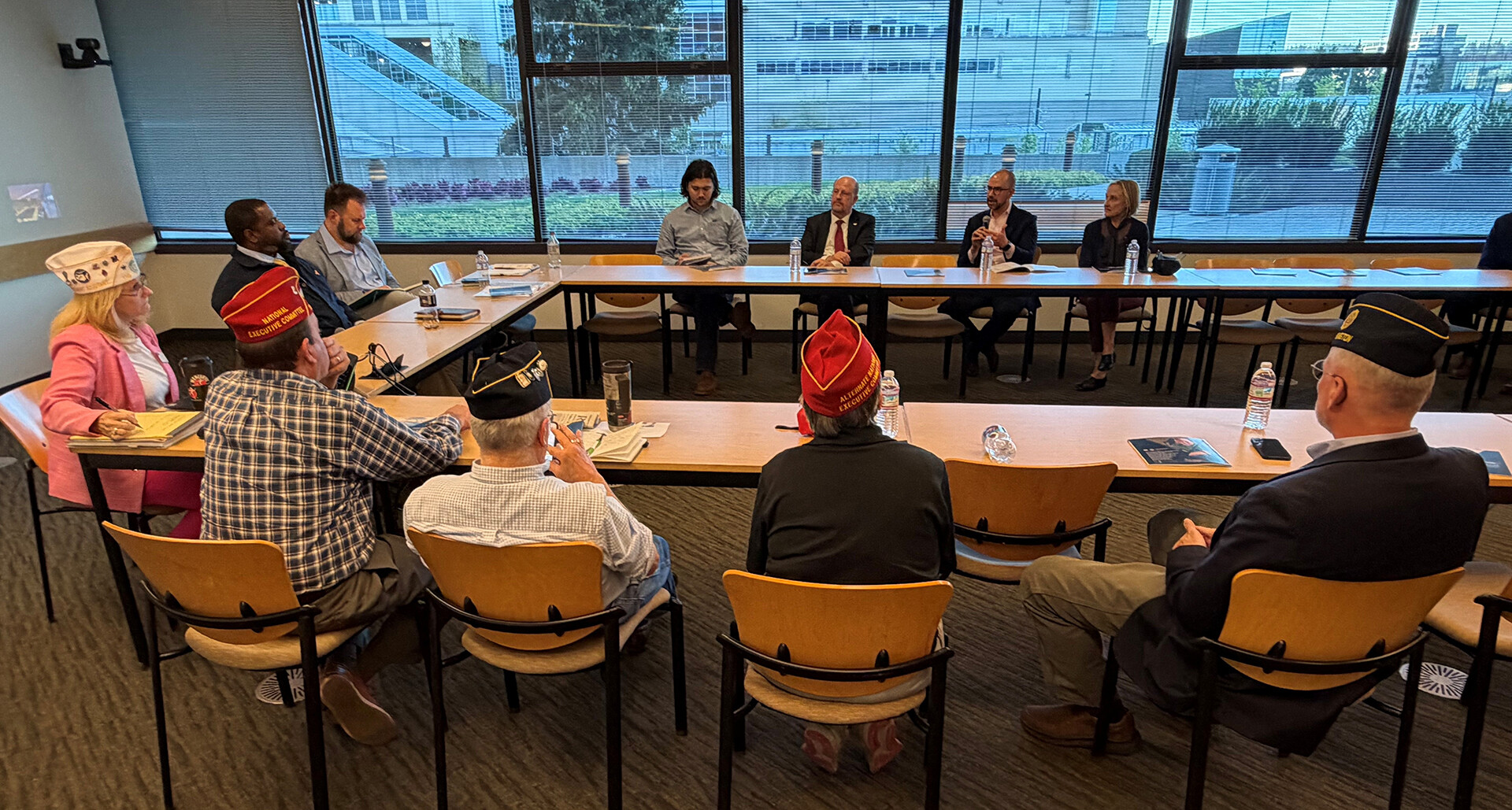
Support from the community, including The American Legion, said to be a key to helping veterans find their way during event in Seattle area.
At the onset of The American Legion’s veteran town hall April 30 at Bellevue City Hall in Washington, Veterans Affairs & Rehabilitation Division Deputy Director Brandon McClain laid out the purpose of the event taking place in tandem with the Legion’s System Worth Saving visit to the VA Puget Sound Health Care System (VAPSHCS).
“The purpose of this town hall is … to be a listening session,” McClain said. “To bridge the gap between information that may or may not be getting to veterans. To hear from you all.”
A similar message was shared by American Legion Veteran’s Health Policy Analyst Sri Benson, who noted, “The purpose of this is to make your care better and to make the jobs of our VA clinicians and staff easier.”
And while that occurred, the town hall also turned toward an issue of the upmost importance to The American Legion: veterans’ mental health treatment, with an end goal of preventing suicide. That’s the goal of the Legion’s Be the One mission, which McClain called the Legion’s “flagship program” and shared his own issues in dealing with mental health treatment.
McClain, who deployed to Afghanistan twice during his U.S. Army service from 2010 to 2018, said his major issue is wait times for mental health appointments. “There’s been inconsistencies with a number of providers,” he said. “There’s a tendency to just be virtual, and for me, personally, I don’t like doing it that way. So I haven’t been as connected as I should have.”
Department of Washington Adjutant Barbara Lombrano expressed similar concerns with mental health treatment and noted that wait times for appointments using Community Care can result in even longer wait times.
VAPSHCS Chief of Staff Jesse Markman said while VA does have emergency mental health care options, many veterans are hesitant to use them because they feel someone else may need it more. He encouraged the Legion to counter that way of thinking. But he also said when it comes to mental health treatment, there are difficulties with scheduling appointments.
“Our wait times are long for mental health care. In particular, it’s waiting for psychotherapy,” he said. “You’re talking 12 to 16 weeks. And a therapist can only carry so many cases at once. And that is also true of the State of Washington. We are one of the least per-capita areas for mental health in the country. The reality is we don’t have enough mental health providers.”
Markman said VA Vet Centers are great for linking up with community resources and locating peer support for those not comfortable talking about their mental health in a VA setting. He also added that VAPSHCS also had the second-highest rate of any VA facility making connections for veterans to the Veterans Crisis Line.
But he said organizations like The American Legion also play a major role in addressing mental health and suicide prevention.
“I think that the community engagement that you all do at your posts is really helpful,” Markman said. “Having social connectedness, in addition to having purpose, are some of the most valuable things that we can provide, but we can’t give that to people. That is something that the community has to be present, and we work to help them engage with that.
“The work that you all do is invaluable to support the work that we all do. That is really incredible and helpful. Having those areas that allow people to connect which don’t look like, feel like, smell like us, is so important for them to have these things in their lives that make their lives worth living.”
Executive Director Thomas Bundt, who spent 30 years in the U.S. Army and another two in the Army Reserve, echoed that sentiment. “Oftentimes when many of us leave the service, we lose a piece of ourselves,” he said. “It’s very difficult to find that connection, that same type of camaraderie in the civilian sector. And, I think, a lot of it also resolves around employment.
“Notice these things I’m talking about are really not health care-related. They’re more life-related. So friends, social connections, recreational activities, finding work, fiscal education … most of these would be done through (veteran service organizations).”
The town hall, which was attended by both local Legionnaires and Department of Washington leadership that included National Executive Committeeman Rafael Munoz-Cintron and Alternate National Executive Committeeman Carol Reed, also generated other discussions.
Lombrano said he had to go to an urgent care clinic in January; the clinic received authorization from VA to treat her. “They ended up doing a chest X-ray, but yet, I ended up getting a bill for the chest X-ray, but not for the visit,” she said. “So then I’m on the phone calling and calling trying to talk to somebody because the billing is saying, ‘You’ve got to contact the VA.’
“So I contacted the VA and they said, ‘OK, we’ve got it all taken care of. We’re going to have them rebill it.’ I called urgent care and they said they rebilled it. I’m still getting text messages, letters and stuff (from urgent care) saying, ‘You owe this bill.’ That’s just one instance for me.”
Markman admitted her situation is not an isolated one. “I disagree with you,” he said. “We are working hard to try to and improve that. The great part about the Community Care network is that it’s very robust. The really challenging thing about the Community Care network is almost every single one of those are individual entities. And so, we struggle some, particularly since we don’t manage them. TriWest does that. So that feedback is really important for us with individual cases.”
Skagit County Service Officer Chris Diaz, a member of American Legion Memorial Post 91 in Burlington, brought up concerns with VA’s Community Care program.
“I have friends that work at the Mount Vernon (VA Clinic), and I said, ‘Hey, I keep getting people asking me questions about, ‘How do I call Community Care? And why am I on the phone for an hour?’ As you guys know already, that’s been a big issue.”
Bundt said he’d attended a town hall the night before where the same questions were asked. He urged veterans to urge VA’s My HealtheVet, an online platform that allows users to manage their VA health care in the same place they manage other VA benefits and services.
“It can talk back with you and your Community Care provider,” Bundt said, noting VAPSHCS gets 16,000 Community Care referrals each month. “It might not be as fast as you like it to be, but it’s there and it’s present.”
Chad Magendanz, commander of American Legion Post 79 in Snoqualmie and a former two-term state representative, asked how an executive order signed by President Trump in mid-April will impact veterans’ care. The order is aimed at accelerating research and improving access to emerging therapies, including certain psychedelic treatments for mental health conditions affecting veterans.
“I would say we have active research trials in motion at our VA, as well as other sites,” Markman said. “To be really clear – and I will preface with I am very interested in treatments that have potential for mental health, period, because we don’t have enough treatments. But in my career, I’ve seen a whole lot of things that have come and gone that get a lot of excitement and press because people are so interested about possibilities and change. And I’m not trying to downplay this at all.
“I’m just saying that it’s really smart to wait for the evidence, rather than the anecdotes. It has been challenging to do research in this area, as well as areas with other substances, because of limits for funding. That makes it challenging to explore. But I think that’s really encouraging – ways that will allow more studies and more research.”
Magendanz also brought up concerns that there wasn’t a good mechanism in place to transition homeless veterans from community programs to getting VA assistance, as well as no one currently to coordinate the effort.
“We would love to connect you or whomever at your post with our homeless services,” Markman said. “We have wide-ranging services that work very closely with different county partners, and they could do some collaborative training … to be more effective in connecting veterans with what resources are available.”
- Veterans Healthcare