
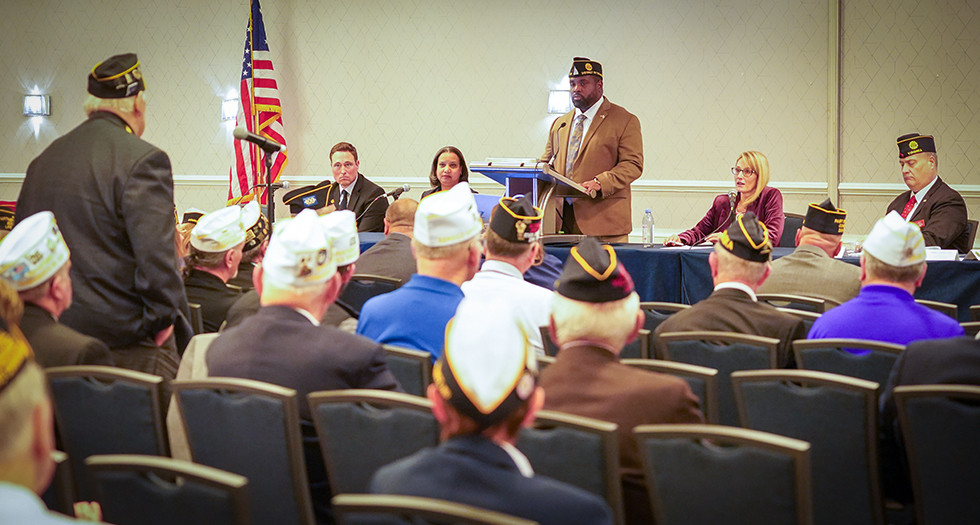
Legionnaires hear from U.S. Department of Veterans Affairs leadership during Washington Conference.
A group of panelists from various arms of the U.S. Department of Veterans Affairs briefed The American Legion’s Veterans Affairs & Rehabilitation Commission during the recent Washington Conference. The discussion included the delivery of disability claims benefits, community care and the importance of relationships with organizations like The American Legion.
Veterans Benefits Administration (VBA) Compensation Service Executive Director Nina Tann shared the progress her agency has made in processing benefits claims, noting that 3 million claims were processed last year, a figure VBA expects to hit again this year. But she added that the speed of processing claims has to be balanced with accuracy.
“We continue to try to create that balance to make sure that we’re not only shortening wait times for decisions, but we’re also rendering accurate decisions and taking full consideration into what evidence is submitted,” Tann said. “We work really closely at VBA with our Office of Administrative Review, with our Office of General Counsel, as well as with the Board of Veterans Appeals.
“Part of what we’re doing is really trying to refine the data. We’re looking at our processes. We’re looking at what we’re finding through our higher-level reviews of our initial claims, as well as remands from the board, to make sure we’re using that information … so we’re reducing rework and a very frustrating experience for veterans that can take a really long time if we don’t get it right the first time.”
While technology is advancing, the human aspect of VBA remains a priority. “As we continue to look at automation, and we’re constantly put into a position where we trying to leverage technology as best we can, our claims processors remain very much a part of that process,” Tann said. “They continue to be trained and look at how we evaluate and weigh evidence. They are still a part of every part of that process.”
Alicia Skolrood, the Veterans Health Administration’s (VHA) Executive Director of Integrated External Networks, spoke mainly on providing the best way for veterans to seek care from an outside provider when VA care isn’t available or preferred.
“What we can do within VA, and with our direct care support and care coordination with all of the incredibly benchmarkable level of health care that you can get inside the VA, and supplement that with the very best of industry,” Skolrood said. “That’s what we’ve attempted to change with these contracts. The level of accountability we have with these (third-party administrators) is No. 1. No. 2 … when you purchase care externally and you provide direct care, those are very different styles of leadership. Those are very different things that you look for. So, we want to make sure the folks running the purchased care have that expertise. Making sure the infrastructure in VA, within VHA, supports that purchased care.
“My hope for you is that all you notice is better care, better access to care and that all of the sausage making behind the scenes you don’t have to worry about. That’s the ultimate goal: that it just looks really seamless, and you guys notice your access is better, your care gets better. That’s really what our success will be measured on.”
Skolrood was asked if VA undergoing a reorganization that VA Secretary Doug Collins has previously mentioned would impact community care. “Our plan for (community care in) VHA is for that to be separated out from the direct care oversight, where it currently sits,” she said. “This structure would allow us to bring in the expertise from industry, because running a hospital and purchasing the care is very different. We want to make sure that quality of care is there, that our outcomes are there, and all of that sort of has to meet at the middle.”
Tann said opportunities to get in front of groups like The American Legion is critical to success. “Our stakeholder support engagement is critically important, and we are always listening,” she said. “Whether that be we host listening sessions, whether you’re responding to public comment, whether you’re just reaching out to us directly … we take very seriously the input that our stakeholders provided.”
“Continue that communication piece and funnel things up. We don’t have eyes on everything,” added Garrison Pietrowiak, assistant director for VA’s Penson and Fiduciary Service.
Following the panel, the commission heard from Glenn Bergmann, founding partner for Bergmann & Moore LLC. His firm provides training to accredited American Legion service officers and also represents veterans who received American Legion claims assistance that have seen their case go all the way to the U.S. Court of Appeals for Veterans Claims.
Bergmann talked about his firm’s relationship with The American Legion, which began in 2017, the appeals process and his firm’s success rate. He also discussed businesses that charge veterans to file a VA benefits claim – which American Legion service officers provide at no charge.
“These claim shark companies worked in removing the law that gave VA teeth in prosecuting them, and they started going after veterans,” Bergmann said. “The law is very clear. These claim agents don’t care (about being accredited). And the law also says you’re not allowed to charge a fee for filing a claim. Filing claims is the job of the department service officers, and it’s supposed to be free.
“But what has happened is because department service officers are overwhelmed, and because these sharks are also foxes, they are attracting attention and they have gotten wealthy. They’ve gotten wealthy filing claims and charging veterans.”
Bergmann said claim sharks won’t take on complicated cases. “The problem is they’re winning benefits, but they’re going for the low-hanging fruit: presumptives,” he said. “When there’s a presumptive, people who don’t know what they’re doing go in and try to help veterans, charge a fee, and they do no work because VA grants it anyway.
“What these claim sharks are doing is leaving other benefits behind. Health-care enrollment. Suicide prevention. Services for homeless. Education and home loan. They don’t assist in those matters. And it’s offensive.”
- Washington Conference