

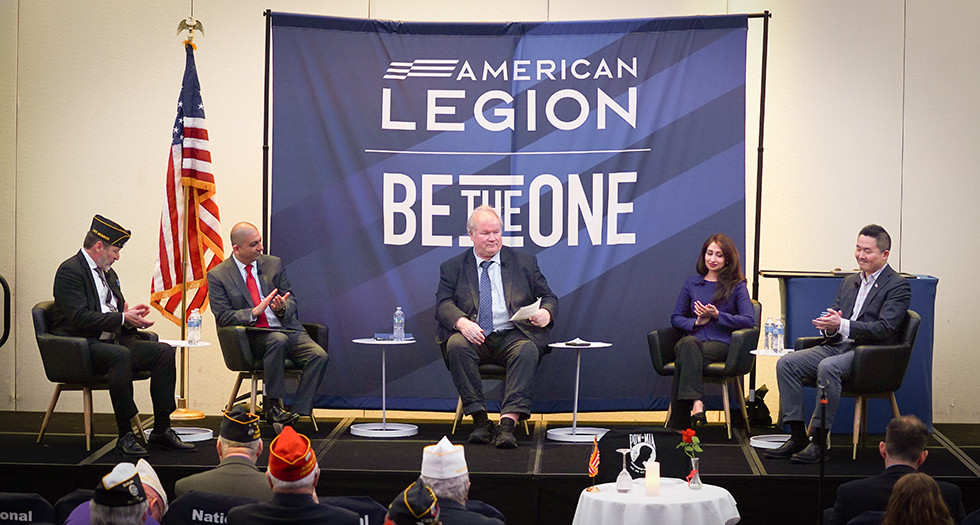
Panelists outline urgency to forge solutions, minimize reliance on adversaries and more during American Legion National Security Commission meeting.
China’s “weaponization” of its dominance in the global race for critical minerals was among the major takeaways during the National Security Commission meeting at the American Legion’s annual Washington Conference March 2.
Panelists focused on the United States’ critical dependency on foreign adversaries, primarily China, for the supply of critical minerals. They outlined why these minerals were essential for nearly all modern electronics, economic activity and defense systems. They identified the core problem not as a lack of raw materials, but as a severe deficit in domestic processing and refining capabilities, a vulnerability that China has strategically exploited and weaponized.
The panel discussion was a follow-up of sorts to the Critical Minerals and National Security Summit at the U.S. Capitol Visitor Center. The American Legion sponsored the Dec. 2 event, which convened experts on a range of topics who discussed how minerals represent a critical priority for the United States when it comes to national security, technological innovation and more.
Critical minerals, such as rare earth elements, cobalt, and lithium, are integral to both the commercial economy (vehicles, phones, electronics) and national defense systems (F-35 jets, AEGIS radar). These minerals will also play a major role in the development of AI (Artificial Intelligence).
Mahnaz Kahn, vice president of policy at Silverado Accelerator, was among the panelists at the commission meeting. She laid out China’s strategy, which involves hoarding the minerals.
“They’re singularly focused on advancing their economy on AI, on energy, on defense, and all that relies on critical minerals,” she said. “It’s this game of master chess. People talk about just the minerals, but you have to think about the minerals serving as the end purpose. Their advancement in AI, innovation, energy, all of it, defense as well.”
The panelists addressed potential solutions, including government-supported onshoring of processing, creating strategic stockpiles, enhancing recycling programs, and forming trade alliances, while also highlighting the significant barriers posed by regulatory hurdles and China’s market manipulation.
Retired Rear Admiral Mark Montgomery, senior director of the Foundation for Defense of Democracies, noted how the U.S. has not held China accountable and Beijing is now repeating what it did to Japan about 15 years ago.
“When you dig a hole for 25 years, you don’t fill it back in in two,” he said, explaining why resolving the decades-long neglect of the critical mineral supply chain would be a long and difficult process.
Jamil Jaffer, executive director of the National Security Institute, outlined China’s perspective of the U.S.
“There is no working with (President) Xi Jinpin,” he said. “There is no work with the China Party. They have it in for us. We need to know that and act accordingly. We got to get real about this. These people look at us as a flashlight. 250 years is nothing to them. They think we’re lighter league and we need to make sure they understand that it’s not the case.”
A solution Jaffer pointed to involved eliminating regulatory policies that undermine progress. “I think there’s real opportunities here in the United States to use American metal, American ingenuity, and apply these challenges even within our larger superstructure. We just have to get rid of the policies that don’t make a lot of sense.”
Qiang Zhong, graduate researcher at George Washington University, offered this advice to individuals wanting to help: recycle electronics.
By recycling electronics, it creates a secondary, domestic source of materials, reducing geopolitical risks and reliance on imports, thereby strengthening the supply chain.
“Instead of selling your electronics on eBay or other online platforms, put them in the used container at Best Buy or trade it in,” he recommended.
Earlier, commission members listened to a briefing on another threat connected with China: vaping.
Ken Mosley, retired special agent at the Bureau of Alcohol, Tobacco, Firearms and Explosives, delivered a presentation on the national security, public health, and economic threats posed by illegal disposable vape products manufactured in and imported from China.
“We don’t know what’s in these vapes,” said Mosley, who is now a consultant for Altria. “We sort of know some of the things that are in there, but not all of them. There are some things you don’t want in your body, including formaldehyde. I don’t want formaldehyde in me any earlier than it needs to be.”
He argued that these products dominate the U.S. market, deliberately evade FDA regulations and are aggressively marketed to children. Mosley detailed how profits from this multi-billion-dollar illicit market fund Chinese national interests and organized crime, including Mexican cartels.
The illicit vape market was estimated to be worth $14.5 billion annually, with $5 billion to $6 billion in profits returning to China, potentially funding its military and geopolitical objectives. “I think that China rips us off enough,” he said. “We don’t have to pay money to put it in their pockets to have them combat us around the world. I have a real problem with that.”
Mosley also highlighted the emergence of “smart vapes,” which connect to your phone. They have surveillance capabilities and are a growing national security risk, he said, noting the proliferation of vape shops around U.S. military bases and schools.
“If they get into your phone, what else do they get into?” Mosley said. “That’s what concerns us most from a national security perspective. Who’s listening? Who has the access? Are they tracking movements? Are they tracking what you search on this thing? Who knows?”
- Washington Conference