

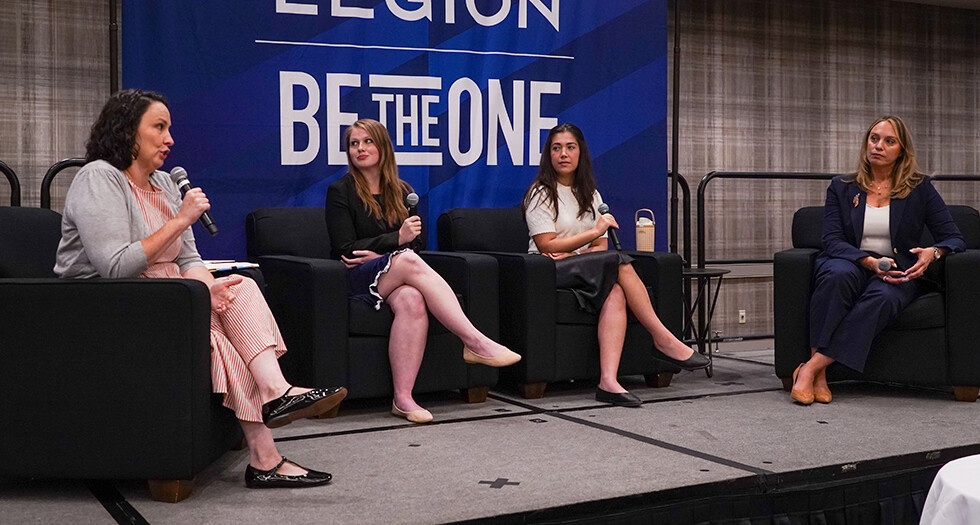
National Security Commission hears about the needs of active-duty servicemembers living on bases and how military retention starts with the family.
The American Legion’s Base Assessment and Servicemember Experience (BASE) program started in 2022 to help improve the lives of servicemembers and their families by hearing directly from them about their needs and then working with the Department of War on improving conditions.
American Legion National Security Division Director Sean Counihan and National Security Policy Analyst Hanna Begun shared updates about two recent BASE visits with members of the National Security Commission during the 107th national convention in Louisville, Ky., on Saturday, Aug. 29. National Security Division staff and department leadership visited Joint Base San Antonio-Fort Sam Houston and Naval Station Great Lakes in Illinois earlier this year.
Counihan said needs that they identified included infrastructure upgrades, staffing shortages, housing policy reforms, dining facility upgrades and food insecurity at Joint Base San Antonio, while Begun said many of the same needs were identified at Naval Station Great Lakes along with dining options for sailors taking evening courses.
“We are committed to ensuring our troops are taken care of as their well-being is paramount to maintaining our national security,” Counihan said. “When I did my tours in Iraq, I was not laser focused if I knew something was going on back home with my wife. If the house is taken care of it allows the troops to focus on their job. And that’s what we want to do because the spouses and families serve with us.”
Immediate Past Department of Texas Commander Richard Huntley was part of the leadership visiting Joint Base San Antonio-Fort Sam Houston, so when he heard about the food insecurity servicemembers were having, he acted. He and other post and department leaders spoke with the local food pantries and other veteran service organizations to start collecting food for the servicemembers to provide a food pantry outside of the base just for them.
“I would bet that everyone of you who has a military base nearby has the same problem. And your local food pantries are great resources,” Huntley said.
A military spouse panel also addressed family readiness needs and factors that influence servicemembers’ decisions to leave the military.
“Everyone in this room understands that when a servicemember serves, the family serves too,” said panel moderator Besa Pinchotti, CEO of National Military Family Association. “And what gets a servicemember to stay is oftentimes their families.”
Faith Murray, legislative coordinator for The American Legion, and Valentina Strouse, an ICU nurse, are married to active-duty servicemembers in the Coast Guard and Army, respectively. Their husbands will be leaving the military over the next year after four years of service to allow Murray and Strouse to follow their career dreams, and to follow a civilian career for themselves.
“Providing services to spouses so they see a pathway to their dreams while their servicemember also serves” is the role Josie Beets has as the program manager for the Department of War’s SpouseWorks, which provides individual career coaching, connections to employers, has scholarships for military spouses to pursue license credentialing or toward an associate’s degree. “We are really trying to find a way that we can support spouses holistically.
“One of the things that we’ve done this year is taken a good look at those foundational sorts of structural issues that military life introduces to a family that prevents a spouse from pursuing a career. That’s the PCS (permanent change of station). Any time you have a military move you’re disrupting that career trajectory and potentially negatively impacting that spouse’s career path.”
Beets shared that SpouseWorks is trying to reduce the impact of PCS by providing consistent childcare, hiring and retaining spouses in the DoW, and creating partnerships with employers.
“We are seeing a renewed focus on the impact of miliary family readiness on warfighter readiness. Everything in the department right now is focused on warfighter readiness and there is an understanding that family readiness is a key part of that,” Beets said. “The thing that’s going to prevent someone from deploying on that nine-month deployment is probably going to be a family issue. So how do we get ahead of that, how do we make sure we are taking care of the families so the warfighter can focus on the mission.”
Strouse, who is stationed at Fort Knox in Kentucky with her husband, said there are many things she enjoys about the military. “I love having that community. In my experience, all I have to do is put a comment on a military Facebook page, ‘Hey, I need this.’ And there’s five to ten responses. The miliary community is awesome. They really do show up for each other.”
However, both she and Murray agreed that having more control over where their spouse received a PCS, how long they are stationed at that base, and better employment opportunities would be a greater incentive to stay in the military.
“If we are going to keep families in the military, we have to provide them with more choice in their future which might mean different approaches to how we approach a military career,” Beets said.
- Convention