

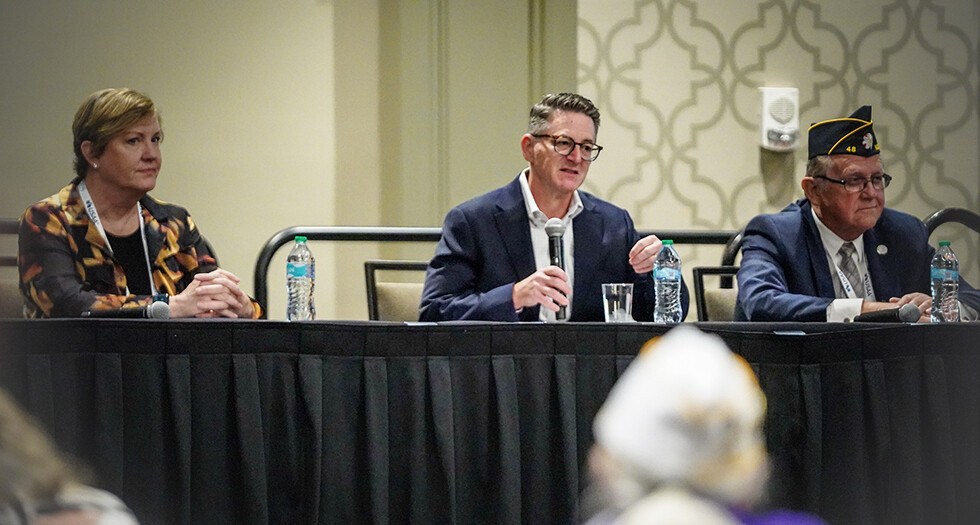
Leaders addressed a Washington Post investigation about fraudulent practices related to student veterans benefits.
While a recent Washington Post investigation found trade schools which fleeced the VA of more than $300 million by teaching useless courses, charging exorbitant tuition, and other acts of GI Bill fraud, a U.S. Department of Veterans Affairs leader said many of the cases in those articles are a decade old and have been dealt with.
“The truth is, many of these were prosecuted because of my staff,” Kenneth Smith, VA’s executive director of Education Services, told The American Legion’s Veterans Employment & Education Commission at their meeting at the 107th National Convention in Louisville, Ky., on Aug. 29.
Still, “We know we can do better, and we’re making investments in tools, both data as well as human tools, to help identify people when they’re doing wrong things, so Joe’s team can withdraw or suspend their people,” Smith said.
Smith was referring to Dr. Joe Wescott, legislative liaison of the National Association of State Approving Agencies (NASAA). Smith, Wescott and Meg O’Grady, senior vice president of military and government programs at National University, were panelists addressing education for veterans at Saturday’s meeting.
Wescott said that, while communication between VA and the SAAs is good, the Post articles “point to a need for more closely working with our VA partner.”
“One of the things that we’re working on right now,” Smith said, “we are moving towards a restructure of our compliance and oversight group which has a direct liaison with the SAAs to put people that are more in line and accountable with exercising our responsibilities to have good oversight over schools, as well as liaise with the state approving agencies.”
While the VA can act quickly to address issues with predatory and fraudulent schools, so can the SAAs. “If we find out there’s a problem with a school, we can deactivate them the next day,” Wescott said.
“This is how the system is designed to work,” Smith said. “In many cases, we bring the evidence, we notify the SAA, the SAA shuts down the school.”
O’Grady added, “If you’re looking at schools, you absolutely should ask them about their relationship with the VA. We (at National University) welcome the compliance. … That compliance is the one thing that can help us identify where there are issues that we may not be able to see.”
In addition to education, Veterans Employment & Education Commission members heard discussion on topics including suicide prevention, homelessness, entrepreneurship and more on Saturday.
Business and entrepreneurship. Three afternoon presentations at the commission meeting looked at trades, entrepreneurship and upskilling business owners in AI.
Matthew Passmore, regional veterans’ employment coordinator for the Department of Labor’s Veterans Employment and Training Service (DOL-VETS), said the panel he was moderating was not just discussing getting jobs.
“We’re talking about building pathways into careers,” said Passmore, whose panel focused on connecting veterans with apprenticeship skills, trades and high-demand careers.
Martin Helms, executive director of Helmets to Hardhats, reminded that GI Bill benefits can be used for apprenticeship programs.
Last year, Hiring Our Heroes developed a skilled trades academy to help address a dearth of skilled tradesmen. Brian Alvarado, senior director of strategic impact and engagement at Hiring Our Heroes, said they are seeing “massive success” in hiring out of the academy at Camp LeJeune. “We can start building a bridge on that gap of hundreds of thousands of skilled jobs that remain open each year.”
A panel of three CEOs — Scott Neil of Horse Soldier Bourbon, Bill Mitchell of HungerRush, and Langdon Root of Semper Tek — discussed entrepreneurship.
All three agreed with moderator Charles Fowler’s question about the necessity of a “one-stop shop” to help aspiring business owners.
“I think you could get a lot of corporate sponsorship out of it as well,” Mitchell said.
They also encouraged Legion posts to, as Neil put it, “be the beacon of entrepreneurship in your community.”
Laura Berrocal, executive director of policy and strategic alliances in Verizon’s Responsible Business Division, said Verizon intends to provide 1 million small businesses with resources to help them thrive in the use of AI by 2030. Her remarks to the VE&E commission came a day after she was one of the featured speakers at Task Force Movement’s meeting at the convention.
Addressing homelessness. A panel of homelessness experts, including Katie Stewart, National Veteran Coordinator, Veteran Justice Outreach, Department of Veterans Affairs, discussed the importance of stability for veterans facing homelessness.
“What would improve their success at getting through a program is stability,” Anthony Love, director of community engagement for the Department of Veterans Affairs, said in regards to veterans facing issues of homelessness, substance abuse treatment and other issues.
Kathryn Monet, CEO of the National Coalition for Homeless Veterans, urged commission members to continue to work in their communities with other agencies addressing homelessness.
“When you look at how we’re solving homelessness, it’s a team sport. … My hope is you keep finding your role on the team,” Monet said.
‘Stories That Matter.’ Leadership of the CARE for Veterans program at Cleveland Play House discussed ways to adapt theatre education for veterans and military communities with trauma.
Tom Kazmierczak, national associate director of education at Cleveland Play House, guided commission members through a variety of activities, including tableaus, aimed at helping them see how to connect.
“Please think beyond theater,” Kazmierczak. “Simply think about connection, purpose … think about healing.”
Participating in those tableaus requires courage, said veterans program director Paul Beres.
“This particular project is going where you guys are,” Beres said of “Stories That Matter,” an initiative funded by the U.S. Department of Education that Cleveland Play House is spearheading. The program, which Cleveland Play House introduced to the commission at March’s Washington Conference, links veterans, educators and students to explore American history and civic identity.
“Our stories are worth telling,” Beres said of veterans participating in the program.
Awards and recognition. Four employment awards were presented in person Saturday:
• Small Employer (50 or fewer employees): ForgeNow, Lewisville, Texas
• Employer of Older Workers: First Command Financial Services, Fort Worth, Texas
• Local Veterans Employment Representative (LVER): Isaac Marquez-Diaz, Round Rock, Texas
• Michael Guty Homeless Veterans Outreach: Dallas Legacy Mission Inc., Dallas, Texas
Three other awards will be delivered, as representatives were unable to attend in person:
• Medium Employer (51-200 employees): Defense Consulting Services, San Antonio, Texas
• Employment Service (Local Office): Workforce Solutions for Tarrant County, Fort Worth, Texas
• Enhance the Lives of Disabled Persons: PRIDE Industries, Dallas, Texas
Awards for Large Employer of the Year and Disabled Veteran Outreach Program will be officially presented during the general session of the National Convention later this week.
The commission also recognized Task Force Movement Executive Director Elizabeth Belcaster for her support of the commission’s efforts.
“My proudest work is bringing all these communities together under the umbrella of Task Force Movement,” Belcaster said. “… We don’t succeed without The American Legion.”
Fowler, the chair of the Legion’s Small Business Task Force, was also recognized for his efforts.
- Convention